




![Van Halen – Everybody Wants Some!! (Live at the Tokyo Dome 2013) [PROSHOT]](https://musicvideosclub.com/wp-content/uploads/2025/10/van-halen-everybody-wants-some-l-360x203.jpg)
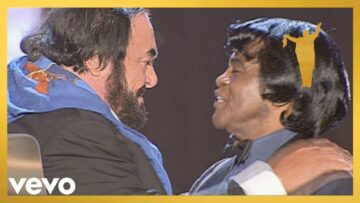
Luis Fonsi – Despacito ft. Daddy Yankee
The Chorus Has Dozens of Words in Spanish — and the Whole World Sang Along Anyway
Luis Fonsi wrote the first lines of “Despacito” in late 2015, sitting at home in Miami. He wanted a song that swung — something rhythmically alive and explicitly sensual, built for dancing rather than radio passivity — and he wanted it in Spanish, without compromise or translation. He had been two years without new music and had a specific feeling he was chasing: what he would later call “a swinging song.” He brought songwriter Erika Ender into the process, and the two of them built a lyric together. By the time the track went into Noisematch Studios in Miami in late 2016 with producers Mauricio Rengifo and Andrés Torres, Fonsi already had a clear structural vision. Daddy Yankee, whose involvement was sought specifically for the reggaeton energy he could bring, improvised his verse in a corner of the studio’s control room on the day of recording. He described thinking about his father playing bongos as he worked through it. He also wrote the post-chorus. The session produced the most-streamed song in the history of recorded music to that point, and no one in the room could have known it.
The video was filmed in December 2016 in La Perla, a working-class neighbourhood of candy-coloured houses on a hillside between the ancient walls of Old San Juan and the Caribbean Sea. Director Carlos Pérez has said that Fonsi and Daddy Yankee arrived with a precise brief: culture, sensuality, colour, dance. La Perla had been known for decades as one of San Juan’s most dangerous areas, avoided by outsiders and largely invisible to the tourist infrastructure of the city. What the video gave it was global exposure. By the summer of 2017, residents were being approached by tourists from Sweden, Morocco, and dozens of other countries asking to be shown the exact rocks where Fonsi sings the refrain, the sea wall where former Miss Universe Zuleyka Rivera appears, the plaza with the domino tables. The section of boardwalk near the filming location had already acquired a name in local tourist brochures: the Despacito coast. Fonsi wrote on Instagram that Puerto Rico was the true protagonist of the song and its video.
The scale of what followed was without precedent in the streaming era. “Despacito” was released on January 13, 2017, through Universal Music Latin. By February it had reached number one on the Billboard Hot Latin Songs chart, where it would spend 35 consecutive weeks and an eventual 56 weeks total — the longest run at the top in the chart’s history since its 1986 inception. In the first three months, the song climbed as high as number 48 on the Billboard Hot 100. Then, in April 2017, a remix featuring Justin Bieber was released. The remix jumped to number nine within a week of release, then to four, then three, then to number one on the chart dated May 24, 2017. It was the first predominantly Spanish-language song to top the Hot 100 since “Macarena” in 1996. Bieber’s manager Scooter Braun had recognised that what was needed was not a translation but a bridge — Bieber sang a Spanglish verse and his presence on radio introduced the original to an English-language audience that had largely missed it. Republic Records chairman Monte Lipman later acknowledged plainly: it took Bieber for the United States to really take note, even as the rest of the world had already consumed the song in its original Spanish-only version.
Sixteen Weeks, Seven Records, One Neighbourhood
The remix of “Despacito” spent sixteen weeks at number one on the Billboard Hot 100, tying the record for the longest reign ever on that chart, which had been held since 1995 by Mariah Carey and Boyz II Men’s “One Sweet Day.” By August 2017, when it tied that mark, it had already been the longest-running number one single of 2017, having surpassed Ed Sheeran’s “Shape of You.” The original video — no Bieber version was ever filmed — became the most-viewed YouTube video in history in August 2017, overtaking Wiz Khalifa’s “See You Again.” It was the first video to reach three, four, five, six, seven, and eight billion views. It held that YouTube record until November 2020, when it was overtaken by Pinkfong’s “Baby Shark.” Fonsi was awarded seven Guinness World Records for the song’s combined milestones. At the 2017 Latin Grammy Awards, “Despacito” won Record of the Year, Song of the Year, Best Short Form Music Video, and Best Urban/Fusion Performance. Billboard awarded it the Latin Song of the Decade in 2020.
What the song produced beyond its own metrics was a structural shift in how the American music industry thought about Spanish-language music. Leila Cobo of Billboard described “Despacito” as the catalyst for renewed label interest in the Latin market. Xander Zellner of Billboard noted that eleven primarily Spanish-language songs debuted on the Hot 100 in 2017 — a consequence, in part, of the commercial proof the song had provided. Songwriter Desmond Child and Cuban musician Rudy Pérez were among those who drew the direct comparison to Ricky Martin’s “Livin’ La Vida Loca” in 1999 as the last moment a Latin song had demonstrably changed the course of pop music globally. Fonsi himself put it carefully: the song had opened a door for the non-Latin world to respond to Latin music, but the movement was the sum of many songs and many artists, of which “Despacito” was one part. The video filmed in La Perla in December 2016 — in a neighbourhood the city’s own residents were warned to avoid — became, within months, the most-watched piece of video content in the history of the internet.
The Language That Didn’t Matter
The production detail that Fonsi and Rengifo used to make the chorus more prominent — side-chaining, a technique that silences the surrounding music as the kick drum hits — is invisible to most listeners but accounts for a significant part of the track’s physical impact on the body when played loud. The percussion mix of guache, cowbell, timbales, and güira grounds the song in Puerto Rican and Caribbean sound while the reggaeton energy Daddy Yankee contributes keeps it mobile across genre formats. Robert Joffred of Medium noted the use of a steel-string guitar playing flamenco-style melodies — an unusual choice against the reggaeton framework — and the text painting in the chorus, where the music itself slows perceptibly as the word “despacito” (slowly) is sung. Fonsi said repeatedly that he was not particularly surprised audiences who didn’t speak Spanish wanted to engage with the song. The language, he said, doesn’t matter. What matters is the flavour, the rhythm, the music. The chorus has dozens of words in Spanish. The whole world sang along anyway.