



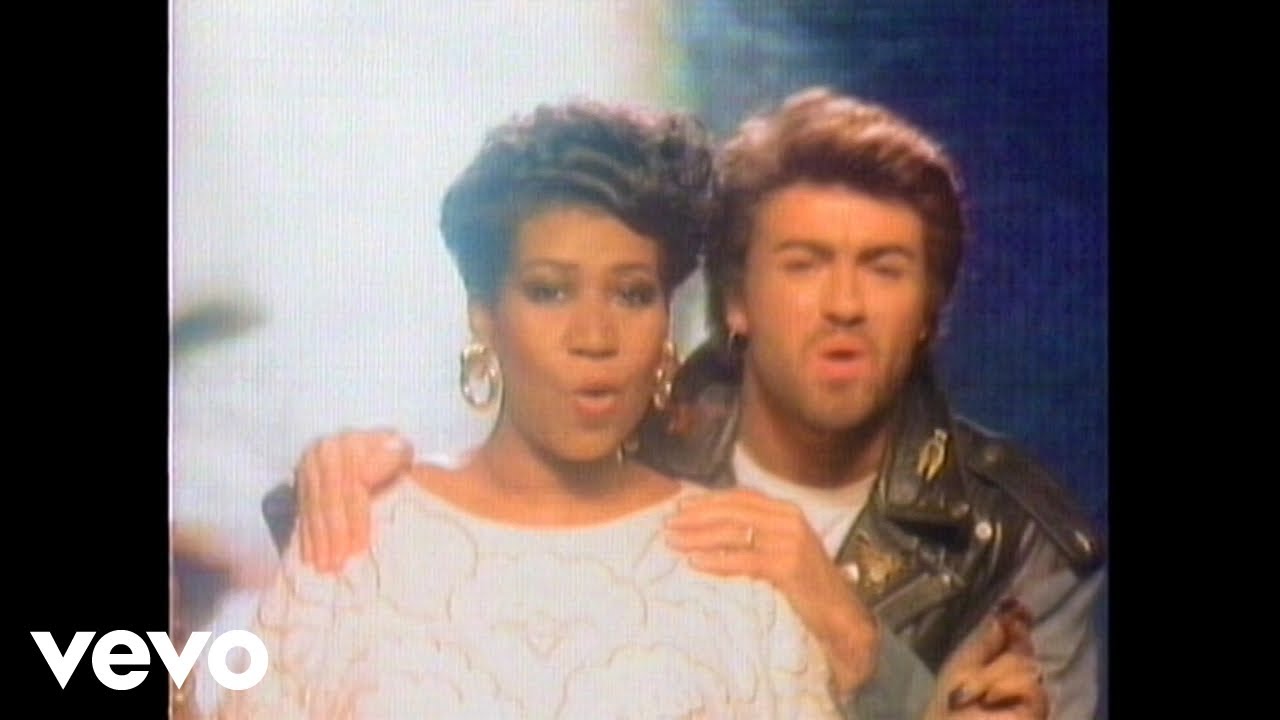




George Michael and Aretha Franklin – I Knew You Were Waiting (For Me)
The Song Had Been Pitched to Tina Turner — Then Clive Davis Had a Better Idea
The session that produced “I Knew You Were Waiting (For Me)” took place in Detroit in May 1986 and lasted two days. Aretha Franklin stood on one side of the microphone. George Michael stood on the other. Franklin was the Queen of Soul, twenty years into a career of such sustained magnitude that the title had ceased to be hyperbole. Michael was twenty-three, freshly extricated from Wham!, not yet having released a solo album, and by his own account “just freaking out.” He wrote about the session in his autobiography Bare: “I’m on the other side of the mic from Aretha Franklin, and she’s treating me like an equal — obviously I’m not, but she was treating me with such respect.” His manager Rob Kahane, present in the studio, recalled Franklin simply belting the song out. Michael knew, in real time, that he was witnessing something he had no business trying to match. “Nobody can emulate Aretha Franklin,” he said later. “It’s stupid to try. I just tried to stay in character, keep it simple — it was very understated in comparison to what she did.”
The song itself had arrived at this unlikely pairing by a circuitous route. “I Knew You Were Waiting (For Me)” was written by Simon Climie and Dennis Morgan — their third composition together since meeting in London in 1983 when Morgan attended an Everly Brothers reunion concert at the Royal Albert Hall. Climie was a Londoner with pop ambitions of his own who would later find chart success as one half of Climie Fisher. Morgan would recall the writing process to The Billboard Book of Number One Hits as simply a gift: “That was one of those songs that came out of mid air — a gift from above, if you will.” The song was not conceived as a duet and had been pitched as a solo vehicle to Tina Turner before it reached Arista Records. It was Clive Davis, Arista’s chief executive, who saw the pairing differently — a song about survival and faith being the ideal vehicle for placing his established soul icon alongside the most credible young British pop voice of the moment.
Narada Michael Walden, who had already produced Franklin’s Who’s Zoomin’ Who? comeback album in 1985, handled production. It was the second time in his career that Michael had been produced by someone else — the first being his appearance on Band Aid’s “Do They Know It’s Christmas?” in 1984 — and he found the experience disorienting after years of self-production. He had a difficult time knowing when to stop singing. Walden’s production gave the track its characteristic 1980s gospel-pop architecture: the surging keyboard arrangement, the churning rhythm section, the space built around the two voices that let them lock together on the title phrase and diverge everywhere else. Franklin later compared the experience of recording it to her early Atlantic sessions with Jerry Wexler: “We’d go in the studio and cut songs. If we were happy with what we recorded, Jerry would say, ‘Let’s wait until tomorrow. If we feel the same way then that we do now, maybe we have a hit.’ ‘I Knew You Were Waiting’ had that. Musically, it does not grow old.”
What the Charts Recorded
Released on January 19, 1987, the single reached number one in the United Kingdom on February 7, 1987 — Franklin’s only UK chart-topper in a career spanning more than two decades, her first UK top ten since “I Say a Little Prayer” in 1968. For Michael, it was his third consecutive solo UK number one following “Careless Whisper” in 1984 and “A Different Corner” in 1986. In the United States it topped the Billboard Hot 100, displacing “Nothing’s Gonna Stop Us Now” by Starship — a record that had itself been produced by Narada Michael Walden, making him the eighth producer in the rock era to score back-to-back number ones. Billboard would later list “I Knew You Were Waiting (For Me)” as Franklin’s all-time biggest Hot 100 single, and it reached number two on the Adult Contemporary chart. It was Franklin’s first American number one since “Respect” in 1967 — twenty years earlier — and, as it turned out, her last. At the 30th Grammy Awards in 1988, the pair won Best R&B Performance by a Duo or Group with Vocal. The official music video, directed by Andy Morahan, placed the two in separate spaces — connected by a giant screen through which they watch each other — until the sequence finds them in the same room. Franklin’s sister Erma was on set. “He was very friendly and personable, easy to talk to,” Franklin recalled.
The album on which the song appeared, Aretha, was Franklin’s thirty-first studio record. Its cover was designed by Andy Warhol — the last commissioned artwork he completed before his death in February 1987. The record also included a hard rock cover of the Rolling Stones’ “Jumpin’ Jack Flash,” recorded as the title song for the Whoopi Goldberg film, and “Rock-A-Lott,” whose vocals were later sampled in the 49ers’ 1990 hit “Touch Me.” But it was the duet that defined the album’s legacy — a specific collaboration at a specific moment, two voices from different generations and traditions meeting on a piece of writing that asked, essentially, whether what you’d been through had been worth it. Michael died on December 25, 2016, aged fifty-three. Franklin followed on August 16, 2018. The video that carries this page is posted on the George Michael YouTube channel, and it remains, as Franklin predicted, a record that does not grow old.
SONG INFORMATION
![Madonna – Open Your Heart (Official Video) [HD]](https://musicvideosclub.com/wp-content/uploads/2026/01/madonna-open-your-heart-official-360x203.jpg.webp)