



![David Lee Roth – California Girls (Official Video) [HD]](https://musicvideosclub.com/wp-content/uploads/2026/10/david-lee-roth-california-girls-360x203.jpg)





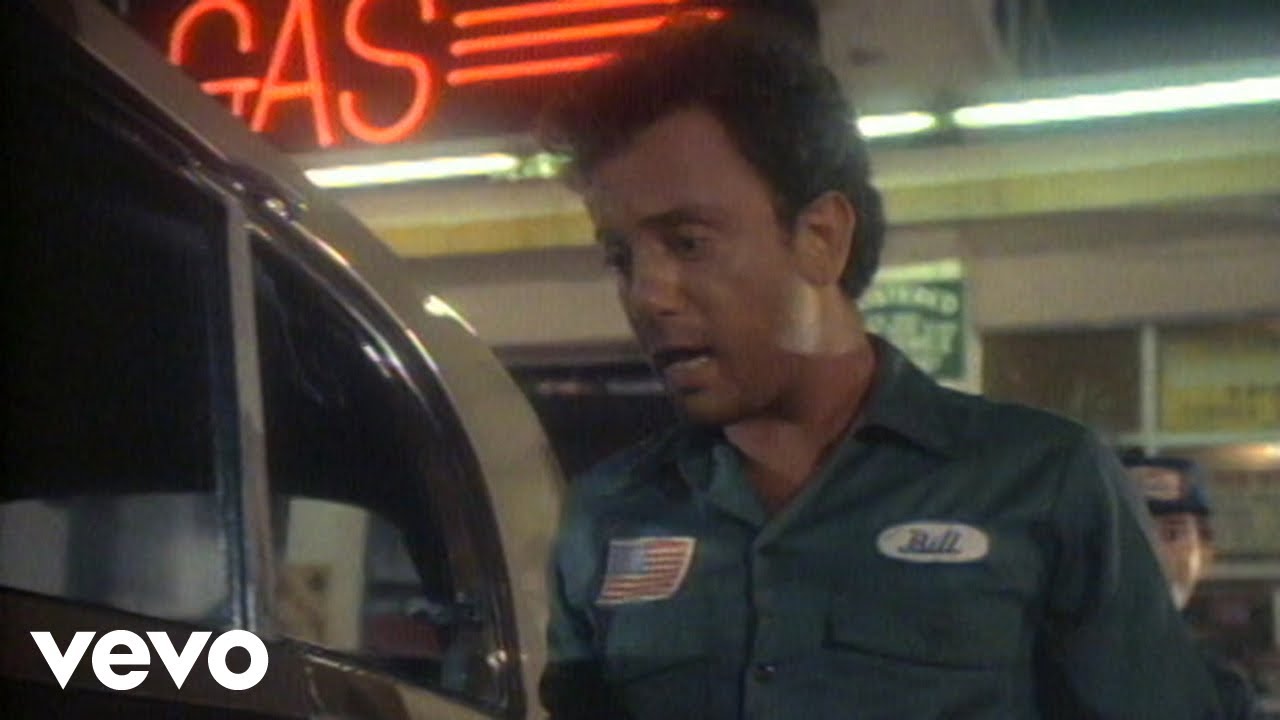
Billy Joel – Uptown Girl
The Song Was Originally Plural — “Uptown Girls” — Because Three Supermodels Had Stood Over His Piano in the Caribbean. Then Elle Macpherson Went to Europe, Christie Brinkley Stayed, and the Song Collapsed Down to One.
Billy Joel was on holiday in the Caribbean, sitting at a piano in a beachfront bar, when he looked up and saw three of the most photographed women on Earth standing in front of him in a half-circle, watching him play. Christie Brinkley. Elle Macpherson. Whitney Houston, who at that point in 1982 was still working as a model more often than as a singer. Joel — newly divorced from his first wife Elizabeth Weber, single for the first time since he had become a rock star, thirty-three years old and a working-class kid from Hicksville, Long Island who had spent his teenage years driving past the rich neighborhoods on the North Shore — looked at the three of them and decided he should probably write that down. The first version of the song, titled Uptown Girls in the plural, opened with the line “Uptown girls, I’ve been all around the world.” It was, he has admitted in interviews since, terrible. The music underneath it was vaguely classical. None of it survived to the finished record.
What survived was the Caribbean encounter and the impulse it produced. Joel started dating Macpherson. They were on and off for a couple of months. She left for a modelling job in Europe, and he assumed that was the end of it. He started dating Christie Brinkley not long afterward — and the song, still unfinished, quietly contracted. The plural collapsed into the singular. The “uptown girls” became one specific uptown girl. The classical music underneath dropped away and was replaced by something the band would later identify as a deliberate Frankie Valli and the Four Seasons pastiche — close harmonies, doo-wop chord changes, a falsetto Joel hadn’t really used before, and the bouncing piano figure that anchors the verse. Drummer Liberty DeVitto has said that during the An Innocent Man sessions at A&R Recording Studios in New York, the band would put on Drifters and Four Seasons records in the control room while waiting between takes, and Joel would point at the speakers and say he wanted to write something that sounded like that. Uptown Girl was one of the songs that came out of those listening sessions.
The two hottest days of the New York summer
The album that contained it, An Innocent Man, was released on August 8, 1983, and was Joel’s deliberate love letter to the doo-wop, soul, and early-1960s pop he had grown up with on Long Island. The single came out in September 1983, with the band that had played on every Joel record since Turnstiles in 1976 — Liberty DeVitto on drums, Doug Stegmeyer on bass, David Brown on lead guitar, Russell Javors on rhythm guitar, Mark Rivera on percussion and saxophone — and Phil Ramone, the Brooklyn-born producer who had shaped Joel’s records since The Stranger, behind the desk. The video, directed by Jay Dubin, was shot in New York over what Joel later called “the two hottest days of the year.” Joel and the band played auto mechanics in a downtown garage. Brinkley, by then his girlfriend, played the title character — pulling up in a 1958 Rolls-Royce limousine whose owner, according to Dubin, tried to extract two thousand dollars from the production for a fictitious leaking radiator before being caught out by Dubin’s line producer, who simply offered to buy the supposedly broken radiator outright. The radiator’s leak miraculously vanished. The shoot continued. A poster of Brinkley advertising a fictitious brand called Uptown Cosmetics looms behind Joel and the dancing mechanics in the garage’s window.
The single climbed to number three on the Billboard Hot 100 in the autumn of 1983, where it sat for five consecutive weeks between November 12 and December 10, blocked from the top by Lionel Richie’s All Night Long (All Night) and then briefly by Paul McCartney and Michael Jackson’s Say Say Say. In the United Kingdom, however, it did something Joel had never managed before and would never manage again — it went to number one. On November 1, 1983, it knocked Culture Club’s Karma Chameleon off the top of the chart and stayed there for five weeks, becoming the second-best-selling British single of the year and the nineteenth-best-selling single of the entire decade in the UK, with cumulative sales eventually crossing 1.8 million copies. It was also Joel’s only UK number one in a career that had by then already produced Just The Way You Are, My Life, and It’s Still Rock And Roll To Me. The American chart had always been kinder to him; the British one had been studiously polite. Uptown Girl broke that pattern in a single autumn.
The downtown man who married the uptown girl
Joel and Brinkley married on March 23, 1985, on a yacht moored off Manhattan, sixteen months after the song peaked. Their daughter Alexa Ray Joel was born that December, named in part for the producer Phil Ramone. The marriage lasted nine years. They divorced in August 1994, by Brinkley’s later account because of Joel’s drinking and the punishing scheduling demands of his touring life, and they have remained on good terms in the decades since — co-parenting Alexa Ray, who became a singer and pianist herself and toured with her father in adulthood. When Brinkley published her memoir in 2025, she titled it Uptown Girl and devoted full chapters to her time with Joel. The song’s afterlife, meanwhile, has been remarkable: Westlife took a cover version to UK number one in 2001 as the year’s official Comic Relief charity single; Olivia Rodrigo name-checked the song and Joel directly in her 2021 hit Deja Vu and was invited onto the Madison Square Garden stage on August 24, 2022, to sing the original with him as a duet, with Joel on piano and Rodrigo handling the second-verse vocal that had once been the unspoken provocation of her own song.
Joel, in interviews since, has been characteristically self-deprecating about his own role in any of this. Uptown Girl, he has said more than once, was a song he didn’t enjoy filming the video for — they wanted him to dance, and he wasn’t crazy about dancing, and the heat in the New York summer of 1983 was relentless. In 1985 he said he had given the dancing a try anyway. In a 1987 interview with Q magazine he produced what may be the song’s most-quoted off-the-cuff line: “The fact that I can attract such a beautiful woman as Christie should give hope to every ugly guy in the world.” It was self-deprecation as armour, the working-class Long Island kid acknowledging the absurdity of his own life with a joke. The song itself was never that joke. The song was the moment when a thirty-three-year-old recently divorced piano player — newly single, surrounded for the first time in his life by the kind of women who never noticed him in high school — decided to do what he had always done with that material, which was to write it down honestly. It just happened that this particular time, he wrote it down with a falsetto, a doo-wop bridge, and one of the most recognisable music videos of the entire MTV decade. The plural collapsed to one. The downtown man married the uptown girl. The song outlived the marriage by thirty-plus years and is still climbing.
SONG INFORMATION
Related videos
 Watch LaterAdded
03:30
Watch LaterAdded
03:30  Watch LaterAdded
06:49
Watch LaterAdded
06:49  Watch LaterAdded
04:05
Watch LaterAdded
04:05