








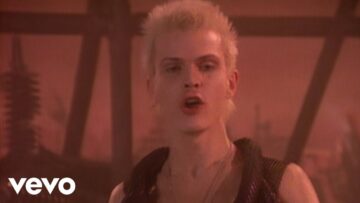
Blondie – Call me
Written In Hours After Stevie Nicks Said No
Released in February 1980 as the theme to Paul Schrader’s neo-noir thriller American Gigolo, “Call Me” became Blondie’s biggest hit and Billboard’s number one single of 1980, spending six consecutive weeks atop the Hot 100 beginning April 19 and remaining on the chart for twenty weeks total. In the UK, it became the band’s fourth number one in little over a year, topping the chart and earning silver certification for 200,000 copies sold. What makes this achievement even more remarkable is that Giorgio Moroder originally approached Stevie Nicks of Fleetwood Mac to record vocals for his instrumental track titled “Man Machine,” but she declined due to a recently signed contract with Modern Records that prevented her from working with Moroder. When Moroder presented Debbie Harry with the instrumental, she wrote the lyrics and melody in just a few hours, transforming a rejected project into one of the decade’s defining tracks.
The single entered the Hot 100 at number sixty in late March and climbed steadily before reaching number one where it stayed from April 19 through May 31, only being displaced by Lipps Inc.’s worldwide smash “Funkytown.” The track also spent four weeks at number two on the US Dance chart and ranked number one on Billboard’s year-end chart for 1980, while also placing third on Canada’s RPM year-end chart. The song sold over one million copies in the United States alone, earning gold certification from the RIAA, while the American Gigolo soundtrack album peaked at number seven on the Billboard 200. Blondie were competing against Queen’s “Another One Bites the Dust,” Pink Floyd’s “Another Brick in the Wall,” and The Knack’s “My Sharona” for dominance, yet managed to outsell them all through 1980 with a sophisticated blend of new wave, disco, and rock that defied easy categorization. Rolling Stone later ranked it number 283 on their list of The 500 Greatest Songs of All Time, while Billboard listed it at number fifty-seven on their All Time Top 100.
Debbie Harry wrote the lyrics from the perspective of Julian Kay, the male prostitute played by Richard Gere in American Gigolo, after watching the film and being struck by the opening scene of Gere driving his Mercedes convertible along the California coast. Harry explained she pictured that coastal drive while writing, capturing the character’s allure, danger, and emotional detachment in lines like color me your color baby, color me your car. The process took mere hours according to Harry, who said the visual impressions from the film provided all the inspiration she needed. Chris Stein later praised Harry’s subtlety, noting that Moroder’s original lyrics were very direct like saying I am a man and I go out and I fuck all the girls, while Debbie’s lyrics are a lot more subtle, and the movie in a way is not that blatant. The bridge included Harry singing call me in Italian and French, adding international flavor that matched the film’s European sophistication.
The recording process happened in three distinct phases across two coasts. First, Moroder and his music crew including keyboardist Harold Faltermeyer recorded an instrumental version at Westlake Recording Studios in Los Angeles, with the tape locked to SMPTE timecode so it would synchronize perfectly with the film. Then the project moved to New York for the Blondie recording session, where the band surprised Moroder by insisting they would play their own parts rather than using session musicians. Faltermeyer was engineering when Harry sang and Chris Stein played electric guitar, though Stein’s guitar and amplifier were buzzing and noisy, requiring repairs to get a clean recording. The band had difficulty locking to the sync, so Moroder stopped the unfinished sessions to save time and took the project back to Los Angeles to add final parts with his own picked musicians, including a keyboard solo by Faltermeyer and drums by Keith Forsey. On the American Gigolo soundtrack album, Blondie the band was credited only for vocals, with Moroder’s crew handling instrumentation. Faltermeyer later said the band was angry about being replaced by session players, but the song turned out to be very successful, so they took it in stride.
“Call Me” was released simultaneously by three different record companies in the United States: the longest version at eight minutes six seconds appeared on the Polydor soundtrack album, the seven-inch and twelve-inch singles were released on Blondie’s label Chrysalis Records, and a Spanish-language twelve-inch version titled “Llámame” with lyrics by Buddy and Mary McCluskey was released on disco label Salsoul Records. The Spanish version was meant for Mexico and South American countries but also received releases in the US and UK, with its CD debut appearing on Chrysalis EMI’s rarities compilation Blonde and Beyond in 1993. In 1988, a remixed version by Ben Liebrand from the album Once More into the Bleach was issued as a UK single, while in 2014 Blondie re-recorded the song for their compilation Greatest Hits Deluxe Redux as part of the two-disc set Blondie 4(0) Ever marking the fortieth anniversary of the band’s formation. Harry also recorded an abbreviated version backed by the Muppet Band for her August 1980 guest appearance on The Muppet Show, first broadcast in January 1981.
The song’s unexpected cultural reach began with a joke. In 1980, KMET DJ Chuck Taylor played the twelve-inch version at double speed and announced in jest that it was the Chipmunks’ latest single. So many requests came for this new Chipmunks release that Ross Bagdasarian Jr. and collaborator Steve Vining rushed to record what became the Chipmunks’ comeback album Chipmunk Punk, which peaked at number thirty-four on the Billboard 200 and became their first gold record. Australian heavy metal band Dungeon covered it on their 1996 demo Demolition and re-recorded it for their 2003 Japan tour CD Rising Power. In 2022, electronic dance music producers Gabry Ponte, R3hab, and Timmy Trumpet released their cover, reaching number eighty on the Dutch Single Top 100, while in 2024 German europop group Cascada covered it for their fifth studio album Studio 24. U2’s 2023 single “Atomic City” credited Harry and Moroder as co-writers given the clear inspiration from “Call Me.” The song appeared in numerous films including Zoolander, where Nikka Costa’s 2001 cover was featured on the soundtrack.
The track earned a Grammy nomination in 1981 for Best Rock Performance by a Duo or Group with Vocal, though it lost to Bob Seger and the Silver Bullet Band’s “Against the Wind.” The music video directed by an unknown filmmaker depicted a New York City taxi driver who had appeared in several other Blondie videos driving his Checker Taxi through Manhattan traffic, creating a gritty urban counterpoint to the film’s glossy Los Angeles aesthetic. This version was part of the 1981 Best of Blondie compilation video. The song marked a turning point in Blondie’s career, bridging their punk and new wave origins with mainstream pop success. It demonstrated their ability to collaborate with European disco producers while maintaining their distinctive identity, paving the way for their continued evolution through Autoamerican and beyond. Looking back, Harry’s ability to write those lyrics in just hours while capturing the film’s essence perfectly stands as proof that sometimes constraints breed creativity, and that being someone’s second choice can lead to defining your career in ways the first choice never could have.