







The Buggles – Video Killed The Radio Star
Peaked At 40 In America—Then Became The First Video On MTV
Released on September 7, 1979, “Video Killed the Radio Star” reached number one in 16 countries including the UK, where it topped the chart on October 20 and spent a week at the summit. The song also reached number one in Australia for seven weeks, France for four weeks, Spain for four weeks, Austria, Ireland for two weeks, Sweden, Switzerland for two weeks, and Japan. In the United States, however, it peaked at number 40 on the Billboard Hot 100 on December 15, 1979, spending just one week in the Top 40 and 11 weeks on the chart total. The modest American performance didn’t prevent the song from changing music history. On August 1, 1981, when MTV launched at 12:01 AM with only a few cable systems carrying the network, “Video Killed the Radio Star” became the first music video ever broadcast, making an aspirational statement about television’s power to reshape the music industry. What nobody knew was that the Tina Charles-funded demo featured Charles herself singing lead vocals, not any actual Buggle, and that Bruce Woolley and the Camera Club featuring Thomas Dolby had released their own version months before the Buggles’ rendition topped charts worldwide.
While “Video Killed the Radio Star” struggled in America during its initial 1979 release, MTV’s launch transformed it into a cultural phenomenon. Record stores in areas where MTV was available reported selling out of The Age of Plastic within weeks of the channel’s debut, despite the album sitting in bins for eight months previously. A Tulsa record store owner told Billboard he’d had 15 copies gathering dust since late 1979, but they vanished within days after MTV started broadcasting. Radio stations weren’t playing the song and almost nobody in America had heard of the Buggles, proving definitively that MTV was selling records and marking an early indication of the network’s influence. In 2015, Billboard tied “Video Killed the Radio Star” with Marvin Gaye’s “The End of Our Road” as the biggest Hot 100 hit to peak at number 40. On February 27, 2000, MTV played the song as the one-millionth video to air on the channel, cementing its place in broadcast history. In 2024, Billboard ranked it number one on their list of the 100 greatest songs about the music industry.
Trevor Horn wrote the song in 1978 after reading J.G. Ballard’s science fiction short story “The Sound-Sweep” about an opera singer in a world without sound who’d been rendered obsolete. Horn later explained he’d spent four years as a loser record producer without ever making money or having success, mainly producing unsuccessful records because he couldn’t lay his hands on a good song. Eventually he got so fed up he decided if he couldn’t find a good artist and a good song, he’d write it himself and become the artist. Horn had been working with keyboardist Geoff Downes after they met at an audition for Tina Charles’ backing band following her UK number one “I Love to Love (But My Baby Loves to Dance).” When Downes showed up with a borrowed Minimoog synthesizer, the two technophiles bonded instantly. They recruited songwriter Bruce Woolley, and the trio wrote “Video Killed the Radio Star” in about an hour one afternoon in Downes’ Wimbledon Park flat above a monumental stonemason’s shop, building around a chorus riff by Woolley.
The first demo featured Tina Charles on lead vocals rather than Horn, with Charles agreeing to fund the project and help secure a label deal. After months of shopping the demo without success, Woolley was courted by CBS for his own solo deal and jumped ship. Just as Horn and Downes were about to sign with Sarm East Studios, producer Chris Blackwell of Island Records heard the demo and offered them a more lucrative deal, which they accepted after Island had rejected them three times previously. Horn claimed Island almost didn’t sign them because the A&R person thought it sounded too much like a jingle. Woolley recorded his own version with the Camera Club featuring Thomas Dolby on keyboards, released as a single in June 1979 with a more straightforward rock arrangement emphasizing electric guitars and reduced reliance on synthesizers. Critics later called Woolley’s version more faithful to the source material, though it achieved only modest commercial performance, reaching number 18 for two weeks on Canada’s CHUM Chart in May 1980.
Recording sessions for the Buggles version took place in 1979 at Sarm East Studios and Virgin’s Town House studios in London using a 40-input Trident TSM console and two Studer A80 24-track tape machines. The production relied heavily on synthesizers including the Roland System 100 for modular sequencing, the ARP Odyssey for lead lines, and a Roland TR-808 drum machine for the mechanical rhythms that defined the track’s electronic backbone. Downes handled most keyboard programming while Horn, serving as producer, vocalist, and multi-instrumentalist, focused on integrating these elements to evoke technological futurism. Horn’s production emphasized innovative layering and effects to simulate the song’s thematic tension between analog radio and emerging video culture. The backing vocals from Debi Doss and Linda Jardim contrasted with Horn’s filtered lead vocal, which sounded like it was coming through a radio itself. The production featured synthesizer strings, subtle guitar flourishes, prominent bass, piano, and a marimba solo in the bridge that gave the track a sanitized futuristic sound perfectly reflecting its theme.
The Age of Plastic, released on January 10, 1980, via Island Records, reached number 27 on the UK Albums Chart and featured the follow-up singles “Living in the Plastic Age,” “Clean, Clean,” and “Elstree,” all of which charted in the United Kingdom. The 11-track album showcased Horn and Downes’ vision of synthesizer-driven pop that blended nostalgia with science fiction edge, drawing inspiration from Kraftwerk’s futurist pulse and the burgeoning synth-pop movement. The B-side “Kid Dynamo” sounded like a theme song for a never-realized superhero cartoon, with its playful melody and futuristic production. Shortly after the album’s release, Horn and Downes joined the progressive rock band Yes after vocalist Jon Anderson and keyboardist Rick Wakeman departed. Horn sang lead vocals on Yes’s 1980 album Drama, the only Yes album to feature him as lead vocalist, while Downes contributed keyboards. The pairing was incongruous—new wave synthesizer pioneers joining a prog rock institution—but it led to further opportunities for both musicians.
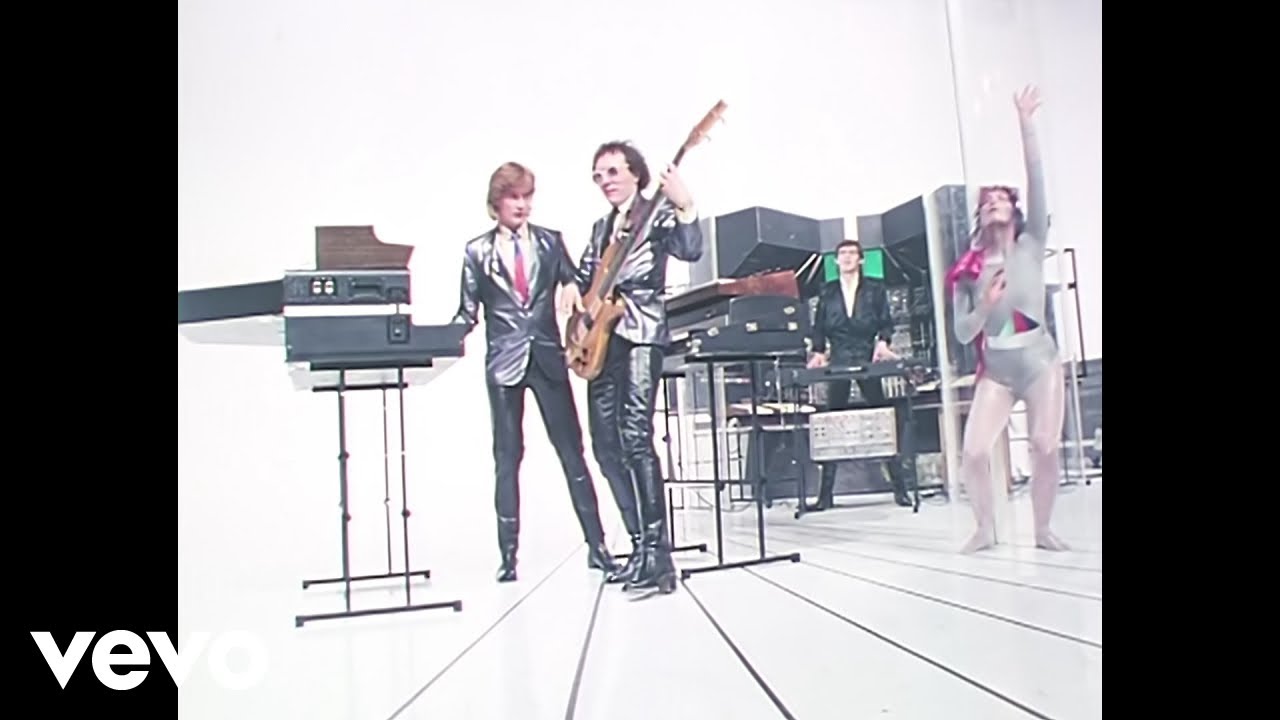
The music video, directed by Australian Russell Mulcahy and produced on a $50,000 budget, was shot in one day in South London and edited over two days. Around 30 takes were required for shots of the actress in the tube. Mulcahy, who’d go on to direct “Living on Video” by Trans-X and films including Highlander and Razorback, created a clip with more production value than most others MTV had to choose from when they launched. The video featured futuristic imagery, radio equipment, and retro-styled performers, perfectly capturing the song’s themes about technology overtaking human artistry. Film composer Hans Zimmer makes a brief appearance in the video before he became famous for scoring The Lion King, Gladiator, Inception, and countless other blockbusters. MTV cofounder Bob Pittman explained the choice of opener by saying the song made an aspirational statement—they didn’t expect to be competitive with radio, but it was certainly a sea-change kind of video.
By the time Horn and Downes released their second Buggles album Adventures in Modern Recording in November 1981, Horn was also producing ABC’s The Lexicon of Love and realizing he was meant to be a producer rather than a performer. The second album peaked at number 161 on the Billboard 200 and didn’t chart in the UK despite being commercially successful in France. Horn went on to produce Frankie Goes to Hollywood’s Welcome to the Pleasuredome, Band Aid’s “Do They Know It’s Christmas?,” Yes’s 90125, Grace Jones’s Slave to the Rhythm, and Art of Noise’s catalog, becoming one of the most in-demand producers of the 1980s. Downes joined Asia and later rejoined Yes. Robbie Williams performed “Video Killed the Radio Star” with Horn at the BBC Electric Proms on October 20, 2009, and titled his eighth studio album Reality Killed the Video Star, produced by Horn. Will.i.am and Nicki Minaj heavily sampled the track for “Check It Out” from Pink Friday in 2010.
The song’s prophetic lyrics about machines overtaking human artistry proved remarkably prescient. Horn’s stoic vocals floated over drum-machine beats and spacey effects, capturing both excitement and unease about technology’s rise. The track predicted the irresistible rise of MTV and music videos in the 1980s, though the irony wasn’t lost on Horn that by singing about video killing the radio star, he was hastening his own obsolescence as a performer. As one critic noted, it’s a deeply sad song delivered like an advertising jingle, a triumph of technological wizardry bemoaning our obsession with technology—the Buggles predicted the future at the same time they warned us against it. Vince Clarke of Erasure, who covered the song for the Other People’s Songs album, called it the perfect pop song. The track’s cultural legacy extends far beyond its chart performance, representing a turning point when television and visual media began overtaking radio as the primary method of music distribution, exactly as the lyrics foretold.
SONG INFORMATION
Related videos
![Eagles – Hotel California (Live 1977) (Official Video) [HD]](https://musicvideosclub.com/wp-content/uploads/2024/09/eagles-hotel-california-live-197-360x203.jpg) Watch LaterAdded
06:45
Watch LaterAdded
06:45  Watch LaterAdded
 Watch LaterAdded
03:52
Watch LaterAdded
03:52