


![The Score – Revolution: Lyrics [Assassins Creed: Unity]](https://musicvideosclub.com/wp-content/uploads/2025/10/the-score-revolution-lyrics-assa-360x203.jpg)




![Lady Antebellum – Silent Night [4K]](https://musicvideosclub.com/wp-content/uploads/2025/12/lady-antebellum-silent-night-4k-360x203.jpg)



![Sister Sledge – Hes the Greatest Dancer (Official Music Video) [4K]](https://musicvideosclub.com/wp-content/uploads/2025/09/sister-sledge-hes-the-greatest-d-360x203.jpg)
![Bruno Mars – I Just Might [Official Music Video]](https://musicvideosclub.com/wp-content/uploads/2026/01/bruno-mars-i-just-might-official-360x203.jpg)





![Van Halen – Everybody Wants Some!! (Live at the Tokyo Dome 2013) [PROSHOT]](https://musicvideosclub.com/wp-content/uploads/2025/10/van-halen-everybody-wants-some-l-360x203.jpg)

Paul McCartney – Pipes Of Peace
His Only Solo Number One In Britain
Released as a single on December 5, 1983, “Pipes Of Peace” became Paul McCartney’s only solo UK number one hit, reaching the top spot for two weeks starting January 8, 1984. But here’s the remarkable context: while this track topped British charts, his duet with Michael Jackson “Say Say Say” simultaneously sat at number one in America, making McCartney the only artist to simultaneously hold the top chart position in both countries with different songs. The UK single sold strongly through Christmas 1983, riding the momentum of its elaborate World War I video filmed at Chobham Common with over 100 extras. What’s especially notable is the geographic split: while Britain embraced the title track, American radio flipped the single, pushing B-side “So Bad” to number 23 while essentially ignoring the peace message entirely.
The chart performance revealed a striking transatlantic disconnect. In the UK, the single spent weeks climbing before its January 1984 peak, earning an Ivor Novello Award nomination for Best Song Musically and Lyrically, though it lost to The Police’s “Every Breath You Take”. The parent album Pipes Of Peace peaked at number four in Britain and spent 23 weeks on the chart, nearly matching predecessor Tug Of War‘s commercial success. America told a different story: the album stalled at number 15 on the Billboard 200, marking what biographer Howard Sounes called slightly disappointing considering the quality of work. McCartney wouldn’t crack the US top ten again until 1997’s Flaming Pie. The single’s video won Best Video of 1983 at the British Rock & Pop Awards, but MTV gave it minimal rotation, likely because American audiences weren’t hearing the song on radio.
The song emerged from an unusual request that transformed into personal mission. Jazz musician George Melly wrote to McCartney asking for a peaceful song for an international children’s organization, something hopeful about the future. McCartney set about writing what he thought would be a charity single, but the composition became something more significant to him personally. His inspiration pulled from multiple sources: Rabindranath Tagore’s poem “Light A Candle,” the August 1965 Watts riots in Los Angeles that popularized the phrase “burn baby burn,” and the 1981 Pestalozzi Children’s Choir album Songs Of Joy whose title appeared directly in his lyrics. The line “songs of joy instead of burn baby burn” wasn’t subtle, but McCartney felt if you could craft an anti-war song that didn’t feel cloying, you’d accomplished something worthwhile.
Recording the backing track took place at AIR Studios in London on September 10, 1982, with George Martin producing and Geoff Emerick engineering. McCartney performed most instruments himself: piano, bass, synthesizer, drums created on a Linndrum machine, plus casaba and kalimba percussion. The challenging element was James Kippen’s tabla performance, which required somewhere between 20 and 30 takes before McCartney was satisfied. Kippen later recalled working with only a click track, Paul’s piano, and vocals initially, trying to interpret McCartney tapping rhythms on his drums and speaking simple syllables imitating tabla players. Adrian Brett added pan flute, while October overdubs brought orchestral strings and horns. Linda McCartney, Eric Stewart, and even young daughters Stella and Mary contributed backing vocals alongside the Pestalozzi Children’s Choir. The final mix wasn’t completed until June 30, 1983.
“Pipes Of Peace” served as both title track and album opener for McCartney’s fourth solo studio album, released October 31, 1983. Most songs actually dated from the 1981 Tug Of War sessions, with only five tracks including the title recorded afterward at McCartney’s Sussex farmhouse studio in September and October 1982. Other singles included the Michael Jackson duets “Say Say Say” and “The Man”, plus “So Bad” which became the US single instead. The album represented McCartney’s attempt to modernize his sound with eighties funk and rock production, likely inspired by his Jackson collaborations. Critics noted the album felt like a weaker execution of Tug Of War‘s formula, with NME’s Penny Reel dismissing it as a dull, tired collection of quasi-funk and gooey rock arrangements. Billboard later cited it among 1983’s unexpectedly disappointing albums.
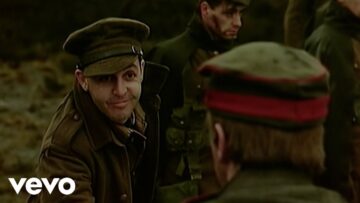
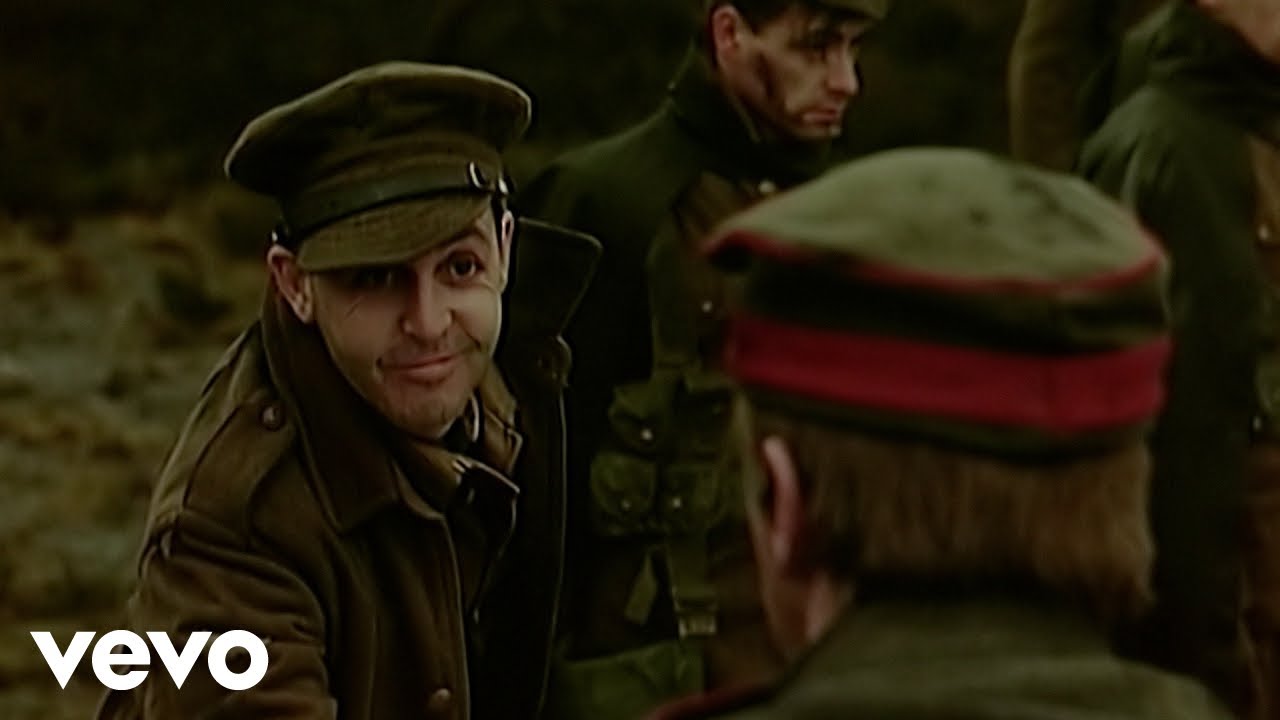
The accompanying music video became nearly as famous as the song itself, depicting the 1914 Christmas truce between British and German troops with McCartney playing both soldiers. Director Keith McMillan filmed over two days at Chobham Common in Surrey using three film crews and 100 extras, with McCartney getting his hair cut short specifically for authenticity. The video portrayed soldiers meeting in No Man’s Land, exchanging photos of loved ones, playing football, then retreating when shells resumed, each man realizing he still held the other’s photograph. The narrative resonated so strongly that in November 2014, Sainsbury’s created a controversial Christmas advert with the Royal British Legion that many recognized as being heavily based on McCartney’s concept, right down to the inadvertent photo swap.
The song’s legacy extended beyond its initial chart run through various covers and cultural appearances. Argentine singer Sergio Denis recorded a Spanish version titled “Pipas de la paz” on his 1984 album La Humanidad. American indie pop band Muna covered it for Capitol Music Group’s 2017 compilation Holidays Rule Vol. 2. The track appeared on compilation albums including 1987’s All The Best!, 2001’s Wingspan: Hits And History, and 2016’s Pure McCartney. In 2015, the Paul McCartney Archive Collection reissued the album as a deluxe package containing the remastered original, bonus demo disc, and film footage. For all the critical ambivalence about the album, “Pipes Of Peace” accomplished what McCartney intended: it became his only solo UK number one, reaching 25 total number ones penned by McCartney in Britain, and it delivered an anti-war message without feeling heavy-handed or preachy, proving that even in the synthesizer-heavy eighties, a former Beatle could still top charts with songs advocating for peace.
SONG INFORMATION
Related videos
 Watch LaterAdded
04:23
Watch LaterAdded
04:23  Watch LaterAdded
03:48
Watch LaterAdded
03:48  Watch LaterAdded
03:07
Watch LaterAdded
03:07