






Giorgio Moroder – From Here To Eternity
Brian Eno Heard “I Feel Love” in 1977 and Told David Bowie: This Changes Everything for the Next Fifteen Years. Three Months Later, From the Same Munich Studio, Moroder Released an All-Electronic Album That Did It Again — and Nobody Noticed Until Decades Later.
The two recordings exist three months apart, and together they form the most concentrated argument for one man’s importance in the history of popular music that a single year has ever produced. In June 1977, Giorgio Moroder and Pete Bellotte released “I Feel Love” with Donna Summer on the Casablanca label — a six-minute track built entirely from a Moog synthesiser borrowed from classical composer Eberhard Schoener, programmed in bursts of twenty to thirty seconds at a time because the instrument went out of tune so quickly, with the only non-electronic element being Keith Forsey’s kick drum, because the Moog could not produce a satisfactory one. Brian Eno heard it and immediately telephoned David Bowie. “I have heard the sound of the future,” he told him. He added that it would change the sound of club music for the next fifteen years, a prediction that Bowie later confirmed was, if anything, conservative. Then in July 1977, Moroder released From Here to Eternity on Casablanca — an album composed, produced, and performed entirely by himself, no vocalist, no band, no session players, nothing except electronic keyboards and synthesisers in a Munich studio. It peaked at number 130 on the Billboard 200. It barely registered commercially. Pitchfork’s Dominique Leone, reviewing the reissue in 2004, gave it an 8.6 out of 10 and called it prophetic. Both assessments were correct.
Giorgio Moroder was born Giovanni Giorgio Moroder on April 26, 1940, in Ortisei — a small town in the South Tyrol region of northeastern Italy, near the Austrian border, where both Italian and German were spoken as a matter of course. He made his early steps in music at the Scotch-Club in Aachen, moved to Berlin in 1966 and began releasing singles under the name Giorgio, singing in Italian, Spanish, English, and German. He came to prominence in 1969 when his recording “Looky Looky” was awarded a gold disc, and by the early 1970s had established himself in Munich and founded Musicland Studios — the room in the basement of the Arabella Sheraton hotel where the Rolling Stones, Led Zeppelin, Queen, Deep Purple, Elton John, and the Electric Light Orchestra would all subsequently record. He discovered the Moog Modular in 1971 through German classical composer Eberhard Schoener, and the encounter changed everything. He partnered with British lyricist Pete Bellotte, brought Donna Summer into the studio for demos, and began building the sound that would define Euro disco through the decade’s middle years.
The Machine That Made Munich Famous
From Here to Eternity was recorded entirely at Musicland. The title track runs five minutes and fifty-nine seconds and opens the album’s first side — the four tracks of which flow together as a continuous suite, interlocking without silence, the sequencer never quite stopping, the tempo never quite shifting to something a human being was naturally producing. The Moog bass sequencer that Moroder had refined through the “I Feel Love” sessions is the engine of the whole recording: a pulsing, mechanical heartbeat beneath synthesiser strings, electronic percussion, and processed keyboard textures that the Discogs community, thirty years later, would describe as sitting side by side with Kraftwerk’s Trans-Europe Express as one of the defining electronic records of the century. The title track single reached number sixteen on the UK Singles Chart — a result that suggested the British dance audience was paying closer attention than the American pop market — and number two on the US Billboard National Disco Action Top 50. The album itself did not chart in the UK. Its moment had not yet arrived, and when it did arrive it came retrospectively, in the way that genuinely prophetic work usually does: through the ears of people who were making the music that came afterward, tracing their own language back to its source.
AllMusic’s John Bush awarded the album four and a half out of five stars and described the metallic beats, high-energy impact, and futuristic effects as proof that Moroder was ahead of his time in a way that Kraftwerk was also — a comparison that the album’s structure invites and that the individual tracks support. “Lost Angeles,” the third track on side one, is a two-minute-forty-four-second piece of melancholy electronic drift that anticipates the ambient techno of a decade that had not yet been named. “Utopia — Me Giorgio,” which closes the first side, is a track whose sequencer pattern is cited by Discogs reviewers as the blueprint of techno — which is not a small claim, and not an inaccurate one. In 2004, Pitchfork placed the album at number eighty-eight in their list of the top one hundred albums of the 1970s. In 2015, Thump placed it at number nineteen in their ninety-nine greatest dance albums of all time. The album has been reissued by Repertoire Records in 1999, remastered again in a 2013 digipak edition with bonus material, and reissued on limited-edition blue vinyl in 2017 — each reissue finding the same audience discovering that the record sounds like the future even now, because the future it was describing has not finished arriving.
What Followed Munich
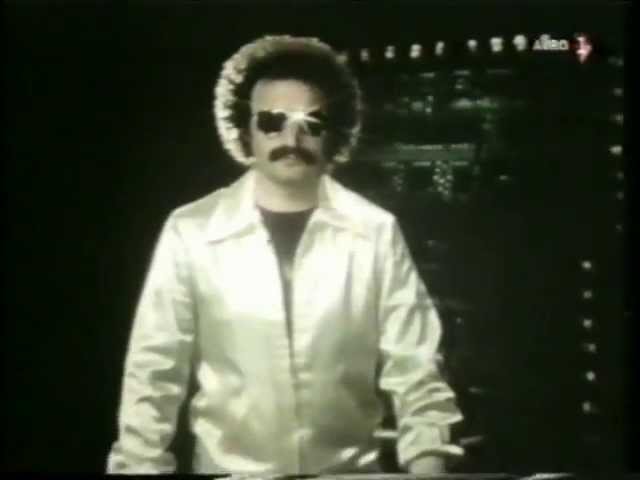
The career that unfolded from Munich after 1977 is, by any measure, one of the most creatively diverse in the history of popular music. Moroder composed the Academy Award-winning soundtrack for Midnight Express in 1978 — collecting the Oscar with Pete Bellotte for Best Original Score. He produced the American Gigolo soundtrack in 1980, which included “Call Me” by Blondie — co-written by Moroder — a US and UK number one. He scored Scarface in 1983, Flashdance in 1983, and composed the opening fanfares for both the 1984 Los Angeles and 1988 Seoul Olympic Games. He collaborated with Philip Oakey of the Human League on the 1984 album Philip Oakey and Giorgio Moroder, which yielded “Together in Electric Dreams.” He co-wrote the Top Gun soundtrack in 1986 with Harold Faltermeyer, which included Berlin’s “Take My Breath Away” and Kenny Loggins’ “Danger Zone.” He holds three Academy Awards, three Grammy Awards, and a Golden Globe. In 2013 he appeared on Daft Punk’s Random Access Memories on the track “Giorgio by Moroder,” narrating his own biography over an eight-minute electronic suite that introduced him to a generation who had been listening to his descendants without knowing his name. The video on this page is from 1977 — the same year as “I Feel Love,” the same year as the album, the same Munich moment in which the father of disco and the architect of electronic dance music was working at a pace and in a direction that the world would spend the next fifty years catching up with.