




![Fleetwood Mac – Go Your Own Way (Official Music Video) [HD]](https://musicvideosclub.com/wp-content/uploads/2026/02/fleetwood-mac-go-your-own-way-of-360x203.jpg)
Steppenwolf – Born To Be Wild
Mars Bonfire Wrote It About a Beat-Up Ford Falcon He Drove Around Los Angeles. Four Publishers Rejected It. Steppenwolf Pressed It as a B-Side. Then a College DJ Flipped the Single — and Heavy Metal Got Its Name Two Years Before Black Sabbath’s Debut.
The song that became the ultimate biker anthem was written by a man who had never ridden a motorcycle. He was driving a used Ford Falcon. He had the lyrics in mind before he had the melody, and he had the title before he had the lyrics. He was broke, living in a Hollywood apartment with a landlord who complained about noise, which meant he had to compose the riff on a Telecaster he could not plug into his amp. He wrote the song as a ballad — slow, folk-flavored, intended for someone with a softer voice than his own. He pitched it to three or four publishers. Every one of them turned it down. He gave it to his brother’s band almost as an afterthought. It became a B-side, then a million-selling single, then the sound of a generation, then — by way of a single throwaway lyric in the second verse — the moment the term “heavy metal” entered popular music.
His name was Mars Bonfire. He was born Dennis McCrohan in Oshawa, Ontario, in 1943, the son of a man who ran the local dance hall called the Jubilee Pavilion. By the mid-1960s he had changed his last name to Edmonton, joined a Toronto blues band called the Sparrows, and made his way to Los Angeles via New York and San Francisco. When the Sparrows dissolved in 1967, his bandmates — including his drummer brother Jerry Edmonton — regrouped under producer Gabriel Mekler’s encouragement and a new name borrowed from a 1927 Hermann Hesse novel. They became Steppenwolf. Bonfire declined an invitation to join. He preferred to write songs.
The Riff That Wasn’t Supposed to Be a Riff
The actual writing of “Born to Be Wild” took place in pieces, the way most songs do. The opening line — get your motor running, head out on the highway — came from the simple physical act of starting his car. The Falcon was beat up but it ran, and Bonfire used it to drive into the canyons, the desert, and the coast around Los Angeles. The famous second-verse phrase about heavy metal thunder came to him during a rainstorm, when the words for the periodic table he had memorized in school surfaced unbidden. He did not mean it as a description of music. He meant it as a description of a motorcycle — except that he had never owned one, never ridden one, and was thinking, when he wrote it, of his own car. The lyric is a private displacement. The song was always about driving. The motorcycles were imposed by everyone who heard it afterward.
He demoed it as a ballad, gentler than the version anyone now remembers, and walked it up and down Sunset Boulevard looking for a publisher. He was turned down by everyone he approached. By the time his old bandmates asked whether he had any songs they could use for their debut album, the demo was sitting unused. He handed it over. He was not in the studio when they recorded it.
From Toronto to American Recording Company
Steppenwolf cut “Born to Be Wild” in late 1967 at American Recording Company on Sunset Boulevard, with Gabriel Mekler producing. The band recorded the entire self-titled debut album in four days. The arrangement was nothing like Bonfire had imagined: John Kay’s voice took the lead with a gravel that no folk reading of the song could have survived; Michael Monarch’s guitar — a Fender Esquire run through a distorted amp — turned the riff into something explosive; Goldy McJohn’s Lowrey organ added the tense, building counterpoint; Rushton Moreve held the bass; and Jerry Edmonton’s drums propelled the whole thing forward at a tempo Bonfire had never considered. The ballad was gone. What replaced it was the kind of recording that defines a band on first contact.
Released on January 29, 1968, the Steppenwolf album was not a hit. The first single, “A Girl I Knew,” went nowhere. The second, “Sookie Sookie,” went nowhere. ABC Dunhill paired “Born to Be Wild” with “Sookie Sookie” as the B-side of the second single — a slot reserved for tracks the label did not believe in. And then a college radio station, somewhere in the country, flipped the record and started playing the B-side instead. The response was immediate. Phones lit up. The label’s promotion team noticed. The A-side was forgotten. By July 1968 “Born to Be Wild” was on the Billboard Hot 100, climbing fast, and by the week of September 14 it had reached number two — held off the top spot by the Rascals’ “People Got to Be Free.” It was number one in Canada on both the CHUM and RPM charts. It sold a million copies and earned Steppenwolf their first RIAA gold record. Mars Bonfire was somewhere in his Falcon, listening to the radio, hearing his ballad come back at him as something he barely recognized.
Easy Rider, and the Placeholder That Refused to Leave
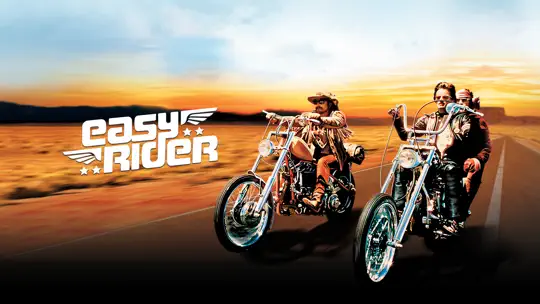
The second life of the song began in 1969, when an unfinished movie called Easy Rider was being edited in Los Angeles. Director Dennis Hopper and producer-star Peter Fonda were making a low-budget biker drama with no money left over for music licensing. As film editor Donn Cambern cut the footage together, he reached for whatever rock music he had in his own record collection and dropped tracks in as temporary placeholders. One of them was “Born to Be Wild,” set against the opening sequence of Wyatt and Billy thundering down the highway on chopped Harleys. Cambern was just trying to make the rough cut watchable. What he had actually done was make the music inseparable from the picture.
Peter Fonda had other plans for the soundtrack. He wanted Crosby, Stills & Nash to write an original score for the film. The trio were flying high in 1969 and Fonda thought their harmonies would set the tone he wanted. Hopper disagreed. The relationship between the two men — already strained from a contentious shoot — broke down further over the music. Hopper later said plainly, in an interview many years afterward, that he sabotaged Fonda’s CSN plan deliberately to keep the placeholder tracks in the film. Steppenwolf stayed. Crosby, Stills & Nash did not. Easy Rider opened on July 14, 1969, and the first sound the audience heard, after the rumble of motorcycle engines, was John Kay’s voice telling them to get their motor running. The song that had nearly been a ballad about a Ford Falcon was now, permanently, the sound of two men on Harleys riding from Los Angeles to New Orleans with cocaine money hidden in a gas tank.
The Genre That Did Not Have a Name Yet
The phrase “heavy metal” was not new. William S. Burroughs had used it in his 1961 novel The Soft Machine to describe a character called the Heavy Metal Kid, and he meant it as a metaphor for addiction — something cold, mineral, and final. But “heavy metal” as a description of music did not yet exist when Bonfire wrote his song. The line in the second verse — heavy metal thunder, racing with the wind — was, like everything else in the lyric, about a moving vehicle. It was not meant to name a genre. The genre did not yet exist to be named. Black Sabbath would not release their debut album until February 1970. Deep Purple’s heaviest work was still ahead. Led Zeppelin’s first record had only just appeared.
But the phrase took. Critics began applying “heavy metal” to the new bands. The lineage traced back, through everyone who tried to name what they were hearing, to a Steppenwolf track that already sounded like an answer to a question nobody had asked yet. Whether “Born to Be Wild” is literally the first heavy metal song is a debate that has run for fifty years and will run for fifty more. What is not in dispute is that the term itself, applied to rock music, started here.
The song was inducted into the Rock and Roll Hall of Fame in 2018 — not as part of Steppenwolf, who have never been inducted as a band, but as one of six inaugural selections in a new singles category. It sits at number 129 on Rolling Stone’s 500 Greatest Songs list and at number 29 on the American Film Institute’s 100 Greatest Songs in Cinema. Mars Bonfire, now in his eighties, has lived for decades on the royalties. He has said that without the song he would probably still be working on the production line at General Motors of Canada in Oshawa. The Falcon is long gone. The song is everywhere.
SONG INFORMATION