





![Kid Rock – All Summer Long [Official Music Video]](https://musicvideosclub.com/wp-content/uploads/2025/12/kid-rock-all-summer-long-officia-360x203.jpg)

Elvis Presley – Can’t Help Falling In Love
Elvis Fought Everyone To Record The Song They Called Too Slow And Soft
Released in November 1961, Elvis Presley’s “Can’t Help Falling In Love” almost never happened. Songwriter George Weiss later revealed that neither the Blue Hawaii movie producers nor Elvis’ associates liked the song demo, considering it too slow and soft for the King of Rock and Roll’s image. Elvis disagreed completely and insisted on recording it for the film. The single reached number two on the Billboard Hot 100 in February 1962, blocked from the top only by Joey Dee and the Starliters’ “Peppermint Twist,” but topped the UK Singles Chart for four consecutive weeks and spent six weeks at number one on the US Adult Contemporary chart. By the time of its release, the Blue Hawaii soundtrack had already hit number one on the Billboard 200 and would stay there for twenty weeks, a record that stood until Fleetwood Mac’s Rumours broke it in 1977.
The chart story reveals unusual staying power. While peaking at number two on Billboard, both sides of the single entered the chart on 4 December 1961, with “Can’t Help Falling In Love” at number 57 and B-side “Rock-A-Hula Baby” at number 62. Variety and Billboard reviewers initially considered the upbeat twist-oriented “Rock-A-Hula Baby” the A-side and more likely hit. They were spectacularly wrong. By January 13, 1962, “Can’t Help Falling In Love” peaked at number four on Cash Box and spent fifteen weeks on that chart. The song would accumulate 75 weeks on the UK Singles Chart across multiple releases, including 28 weeks in 1962, 16 weeks after Elvis’ death in 1977, and 31 weeks in 1993 following UB40’s reggae cover which topped the US chart. A 2020 survey by OnBuy declared it the most popular first dance song at weddings worldwide. Rolling Stone ranked it number 403 on their 500 Greatest Songs of All Time in 2012.
Hugo Peretti, Luigi Creatore, and George David Weiss wrote the song based on the melody of 1784 French love song “Plaisir d’Amour,” composed by Jean-Paul-Égide Martini, who adapted a poem from a novel by Jean-Pierre Claris de Florian. The title originally was “Can’t Help Falling in Love with Him,” written from a woman’s perspective, which explains why the first and third lines end on “in” rather than words rhyming with “you.” The writers initially pitched it to film executives hoping it would work for the birthday party scene where Elvis’ character Chadwick Gates gives his girlfriend’s grandmother a music box. In the scene, the grandmother opens the box, the song plays, and Elvis sings along. The song wasn’t performed to his love interest but to her grandmother on her birthday. Elvis reportedly said he liked songs that go straight to people’s hearts, and this one went straight to his. Priscilla Presley later called it probably one of the most beautiful songs he ever recorded. The song was played at their 1967 wedding and at Elvis’ funeral in 1977.
Recording took place on 23 March 1961 at Radio Recorders studio in Hollywood. Elvis needed 29 takes before getting the vocals right. Joining him were Scotty Moore and Hank Garland on guitars, Floyd Cramer on piano, Bob Moore on bass, D.J. Fontana and Hal Blaine on drums, Boots Randolph on saxophone, Alvino Rey on pedal steel guitar, George Fields on harmonica, Freddie Tavares on ukulele, Dudley Brooks on celesta, and The Jordanaires on background vocals. As the song progresses, the musical backing expands to include the full orchestra beneath Elvis’ tender vocal delivery. The version in the film runs shorter than the three-minute-two-second single release. Interestingly, the track fades out with Elvis repeating part of his 1956 song “Love Me.” Session drummer Hal Blaine, who later entered the Rock and Roll Hall of Fame in 2000, became one of the most successful studio musicians in history, playing on hits by The Beach Boys, Simon & Garfunkel, and Neil Diamond among countless others.
“Can’t Help Falling In Love” appeared on the Blue Hawaii soundtrack, which featured fourteen songs, more than any other Elvis soundtrack. At this point in his career, manager Colonel Tom Parker, booking agent Abe Lastfogel, and Elvis himself felt movies should be the focus. Blue Hawaii became Elvis’ highest-grossing film at the box office, establishing the template for musical comedies he’d continue producing throughout the sixties. The movie, filmed on location in Hawaii just two years after statehood, featured exotic locations, good-looking young people, and a blend of ballads and uptempo numbers designed to capture mainstream audiences. Locals gathered outside his hotel, leaving messages in the sand visible from Elvis’ room. Fans climbed fire escapes, requiring a 24-hour guard. The soundtrack’s twenty-week stay at number one remained unmatched for sixteen years, moving Elvis’ studio recordings into the background as soundtracks dominated his release schedule.
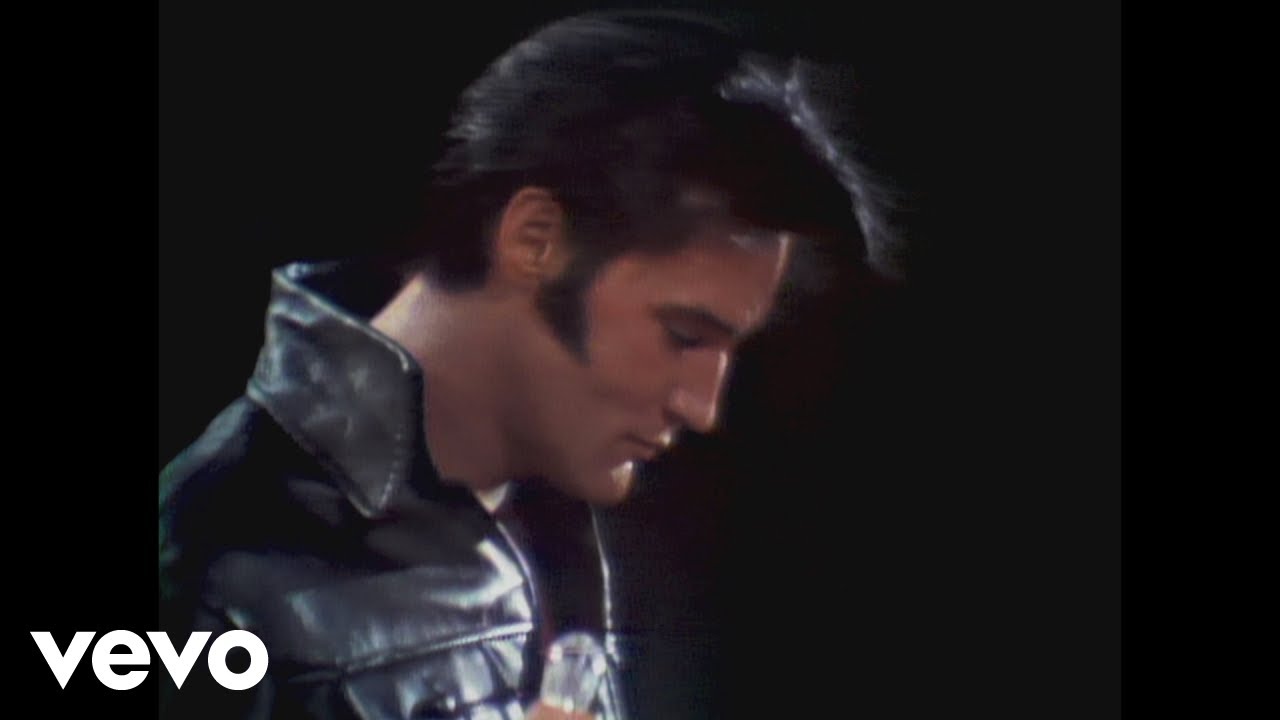
The song’s transformation into Elvis’ concert finale came during his late-1960s comeback. Most notably, he performed a vibrato-rich version during the live segment of his legendary 1968 NBC television special, commonly known as the ’68 Comeback Special, wearing his iconic black leather suit and surrounded by adoring fans. The performance, intimate and emotional, marked Elvis’ return to live music after seven years of focusing exclusively on movies. Filmed on 27 June 1968 during the first stand-up show, the special aired on 3 December 1968 and reestablished Elvis as a musical force. He closed his 1973 global telecast Aloha from Hawaii via Satellite with the song. A version with a faster arrangement appeared in his final TV special, Elvis in Concert. Tragically, “Can’t Help Falling In Love” was the last song Elvis performed live, at Market Square Arena in Indianapolis on 26 June 1977, less than two months before his death.
The covers tell a story of universal appeal spanning genres and generations. Andy Williams took it to number three in the UK in 1970. The Stylistics’ disco version hit number four in the UK in 1976, the year after their hit “I Can’t Give You Anything (But My Love),” also written by George Weiss. Bob Dylan, Marty Robbins, Shirley Bassey, and Engelbert Humperdinck all recorded versions in the seventies. UB40’s reggae interpretation spent seven weeks on the Billboard Hot 100 in 1993, including two weeks at number one, featured in the Sharon Stone film Sliver. U2 ended concerts with Bono singing before Elvis’ original recording played. A-Teens covered it for the Lilo & Stitch soundtrack in 2002. Ingrid Michaelson’s live version reached number 37 on the Hot Rock & Alternative Songs chart in 2011. Kacey Musgraves recorded a version for Baz Luhrmann’s 2022 Elvis biopic, calling it an honor and adventure to reimagine one of the most iconic songs in history.
The song achieved cultural milestones that transcend music charts. In 1962, astronaut John Glenn played a tape recording while orbiting Earth in spacecraft Friendship 7, making it one of the first songs broadcast from outer space. The Fugees sampled Elvis’ voice singing “Wise Men Say” for their 1996 hit “Killing Me Softly with His Song.” English football clubs including Huddersfield Town, Hull City, Swindon Town, and Sunderland adopted it as their anthem from the 1960s onward. In 2015, archival voice recordings of Elvis and his singers were backed by new orchestral arrangements performed by the Royal Philharmonic Orchestra for the If I Can Dream album on the eightieth anniversary of Elvis’ birth. The song entered the Grammy Hall of Fame in 2008. Netflix’s 2024 documentary Return of the King: The Fall and Rise of Elvis Presley highlighted it as central to understanding the 1968 comeback that salvaged his career from mediocre movie soundtracks.
Looking back, “Can’t Help Falling In Love” represents more than just a hit single or a wedding standard. It captured Elvis at a crossroads, fighting for a song his handlers dismissed as too gentle for his image but which he recognized went straight to people’s hearts. The melody borrowed from an 18th-century French composer, the lyrics initially written for a female voice, the recording made for a lightweight beach movie, and the performance to a grandmother rather than a romantic interest—none of it should have worked. Yet Elvis’ instinct proved correct. The song outlasted his movie career, his Vegas period, even his life. As George Weiss, who died in 2010 at age 89, learned, sometimes the King knows best. The song that nobody wanted became the one that defined Elvis’ tenderness, proving he wasn’t just the pelvis-shaking rebel but an artist capable of profound emotional vulnerability. From outer space to football stadiums, from wedding first dances to his final concert, “Can’t Help Falling In Love” endures as the song Elvis fought to record and the world can’t stop loving.
SONG INFORMATION
Chart Performance: No.2 in US (Billboard Hot 100), No.1 in UK (4 weeks), No.1 US Adult Contemporary (6 weeks), No.4 US (Cash Box), Platinum certification (RIAA), Grammy Hall of Fame 2008, 75 total weeks on UK Singles Chart
Related videos
 Watch LaterAdded
 Watch LaterAdded
03:57
Watch LaterAdded
03:57  Watch LaterAdded