



![Eddie Rabbit – I Love A Rainy Night – [Solid Gold Show]](https://musicvideosclub.com/wp-content/uploads/2025/11/eddie-rabbit-i-love-a-rainy-nigh-360x203.jpg)

Lionel Richie – Say You, Say Me
Won The Oscar But Couldn’t Appear On The Soundtrack Album
Released on October 24, 1985, “Say You, Say Me” climbed to number one on the Billboard Hot 100 on December 21, holding the top spot for four consecutive weeks and spending 21 weeks on the chart total. The song also topped the Billboard Adult Contemporary chart for four weeks and reached number eight in the UK, number two in Canada, and number one in Australia, Belgium, Ireland, Italy, the Netherlands, New Zealand, Norway, Spain, Sweden, and Switzerland. It earned gold certification from the RIAA on December 10, 1985, and finished as the number four song on Billboard’s year-end chart for 1986 despite being released in late 1985. The track won both the Academy Award for Best Original Song and the Golden Globe Award for Best Original Song in 1986, cementing Richie’s status as one of the decade’s most dominant artists. What moviegoers and record buyers didn’t know was that the song couldn’t appear on the White Nights soundtrack album because Richie was signed to Motown Records while the film’s distributor Columbia Pictures had a deal with Atlantic Records, creating a contractual impasse that left the Oscar-winning song orphaned until Richie’s next solo album arrived 18 months later.
While “Say You, Say Me” dominated American charts throughout the winter of 1985-86, it became Richie’s ninth number one on the Adult Contemporary chart and his fifth chart-topper on the Hot 100, following “Endless Love” with Diana Ross in 1981, “Truly” in 1982, “All Night Long (All Night)” in 1983, and “Hello” in 1984. This remarkable streak made Richie one of only a handful of artists to score five number ones in a five-year period during the 1980s. The song spent 16 consecutive weeks in the Top 10, demonstrating extraordinary staying power that reflected both Richie’s commercial dominance and the track’s crossover appeal to adult contemporary and R&B audiences. Billboard ranked it the 71st biggest song of the 1980s decade. The success came at a crucial moment for Richie, who was navigating the transition from his phenomenally successful Can’t Slow Down album to whatever would come next, with the soundtrack hit buying him time to craft his follow-up.
Director Taylor Hackford commissioned the song specifically for White Nights, his Cold War drama starring Mikhail Baryshnikov as a Soviet ballet dancer who defects to the West and Gregory Hines as an American tap dancer who’d defected to the Soviet Union. Hackford wanted a ballad that captured themes of hope, friendship, and reconciliation despite ideological differences. Richie later explained he wrote the song thinking about basic human connection and the importance of being there for one another regardless of circumstances or politics. The straightforward message about listening to each other and believing in better possibilities resonated with audiences exhausted by Cold War tensions. Richie crafted the melody on piano, building verses around major key progressions that felt optimistic without being saccharine. The bridge introduced minor tonalities that added emotional weight before resolving back into the major key chorus, creating a sense of overcoming adversity through perseverance and unity.
Recording sessions took place in 1985 with Richie producing himself alongside James Anthony Carmichael and his regular collaborators. Richie played keyboards and programmed the Linn drum machine that provided the track’s distinctive electronic percussion. The production was deliberately sparse compared to the lush orchestrations on Can’t Slow Down, focusing attention on Richie’s vocal performance and the song’s message. Backing vocals were minimal, with Richie’s own harmonies layered throughout rather than bringing in outside singers. This created an intimate quality that made the song feel like a personal statement rather than a big production number. The synthesizer strings that swelled during the chorus gave the track its cinematic quality without overwhelming the fundamental simplicity of the composition. Engineers mixed Richie’s lead vocal prominently, capturing every nuance of his delivery as he moved from gentle verses into the more assertive chorus. The final recording ran just over four minutes, perfect for radio while maintaining the song’s emotional arc.
The contractual disputes that kept “Say You, Say Me” off the White Nights soundtrack created an unusual situation where the film’s Oscar-winning song existed separately from its official soundtrack album. Atlantic Records released the White Nights soundtrack on November 22, 1985, featuring Phil Collins and Marilyn Martin’s “Separate Lives,” which became a massive hit reaching number one, plus tracks from John Hiatt, Michel Colombier, and Lou Reed. But the actual Oscar winner was nowhere to be found. Motown eventually released “Say You, Say Me” as a standalone single in October 1985, creating promotional challenges as radio stations couldn’t direct listeners to purchase a soundtrack album containing the song. The track finally appeared on Richie’s 1986 album Dancing on the Ceiling, released on August 5—nearly ten months after the song had peaked at number one and eight months after winning the Academy Award. This unusual release strategy actually worked in Richie’s favor, as the song’s massive popularity helped launch Dancing on the Ceiling to multi-platinum status.
Dancing on the Ceiling became Richie’s third consecutive multi-platinum solo album, reaching number one in Australia and the Top 5 in America and the UK. The nine-track album featured the title track “Dancing on the Ceiling,” which peaked at number two on the Hot 100, plus “Love Will Conquer All,” “Ballerina Girl,” and “Se La.” The album showcased Richie moving toward a slicker, more pop-oriented sound with heavy use of synthesizers and drum machines that defined mid-1980s production aesthetics. Critics noted the album lacked the warmth and soul of Can’t Slow Down, though it still sold over four million copies in the United States. Richie co-wrote most tracks with Greg Phillinganes and took on nearly all production duties, demonstrating his evolution from Commodores frontman to self-contained solo artist who controlled every aspect of his recordings. The inclusion of “Say You, Say Me” gave the album instant credibility and provided a graceful ballad that balanced the uptempo dance tracks.
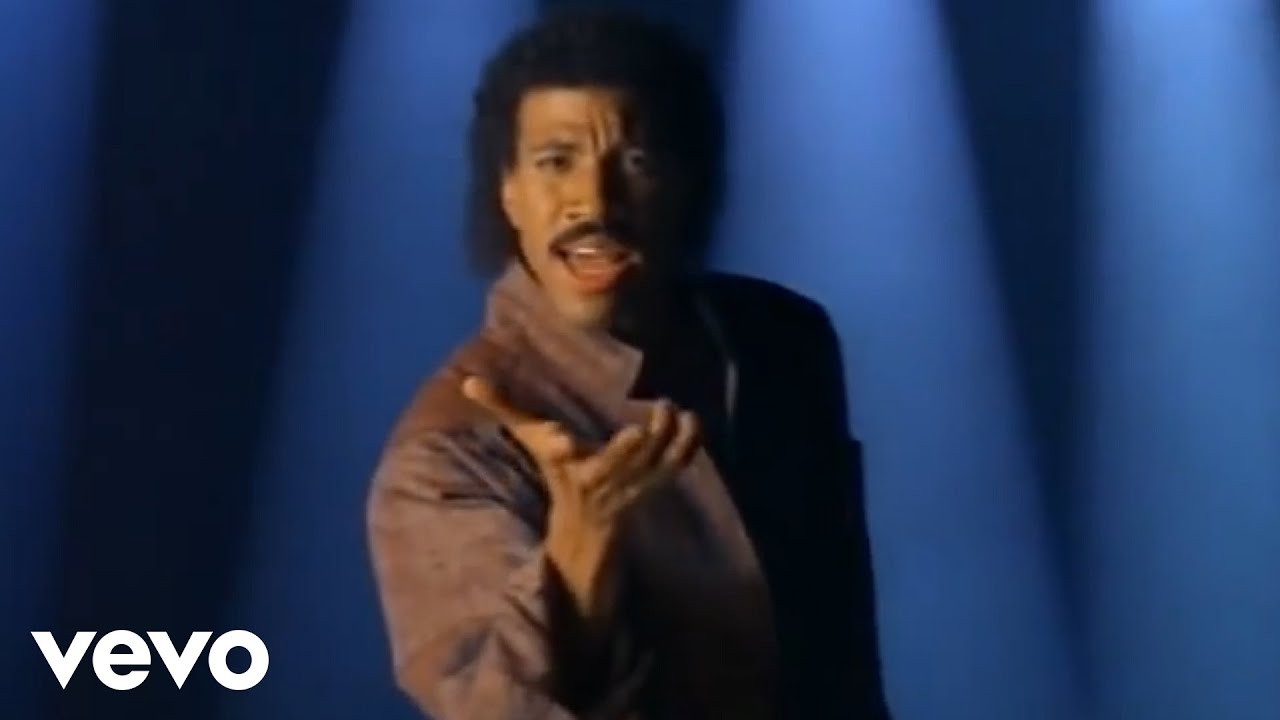
The music video featured Richie performing at a piano in a sparse, minimalist setting with dramatic lighting that emphasized the song’s intimacy. Director Bob Giraldi, who’d previously worked with Michael Jackson on “Beat It” and Pat Benatar on “Love Is a Battlefield,” kept the visuals simple and focused entirely on Richie’s performance. Scenes from White Nights were interspersed throughout, showing Baryshnikov and Hines dancing together in the film’s climactic reconciliation sequence. MTV played the video constantly throughout late 1985 and early 1986, helping drive the song’s lengthy chart run. At the 58th Academy Awards on March 24, 1986, Richie performed the song live before winning the Oscar, beating out “The Power of Love” from Back to the Future and “Surprise, Surprise” from A Chorus Line. In his acceptance speech, Richie thanked director Taylor Hackford for trusting him with such an important assignment and dedicated the award to anyone who’d ever felt alone or misunderstood.
The song became a wedding reception staple throughout the late 1980s and 1990s, with its message about partnership and mutual support resonating with couples. DJs reported it ranked among the most requested slow dances alongside “Endless Love” and “Unchained Melody.” Richie performed it on virtually every tour for the rest of his career, making it a centerpiece of his live shows alongside “Hello” and “All Night Long.” The track appeared on numerous Richie compilations including Back to Front in 1992, Truly: The Love Songs in 1997, and The Definitive Collection in 2003. In 2008, Billboard and MTV ranked it among the greatest Oscar-winning songs of all time, noting how effectively it captured the film’s themes while remaining accessible to audiences who’d never seen White Nights. Richie’s piano-and-voice demo of the song, recorded before the full production, circulated among collectors and appeared on bootlegs, revealing how fully formed the composition was from its earliest conception.
Lionel Richie’s career spans over five decades, with more than 100 million records sold worldwide and five Grammy Awards including Producer of the Year in 1985. After Dancing on the Ceiling, Richie took a six-year hiatus from recording, not releasing another album until 1992’s Back to Front. Personal issues including his divorce from Brenda Harvey and his relationship with Diane Alexander dominated tabloids during that period, overshadowing his music. When he returned, the musical landscape had changed dramatically, with new jack swing and hip-hop dominating R&B charts. Richie adjusted his approach throughout the 1990s and 2000s, releasing albums that incorporated contemporary production while maintaining his melodic sensibilities. His 2012 album Tuskegee reimagined his hits as country duets with artists including Willie Nelson, Shania Twain, and Kenny Rogers, introducing his catalog to new audiences and topping both country and pop album charts. As Richie reflected in interviews, “Say You, Say Me” represented everything he believed about music’s power to bring people together across differences, a message that felt urgent during the Cold War and remains relevant decades later.
SONG INFORMATION
Chart Performance: No. 1 in US (4 weeks), No. 8 in UK, No. 2 in Canada, No. 1 on Billboard Adult Contemporary (4 weeks), No. 1 in Australia, Belgium, Ireland, Italy, Netherlands, New Zealand, Norway, Spain, Sweden, Switzerland; No. 4 on Billboard Year-End Hot 100 (1986); 21 weeks on Billboard Hot 100
Related videos
 Watch LaterAdded
 Watch LaterAdded
 Watch LaterAdded