





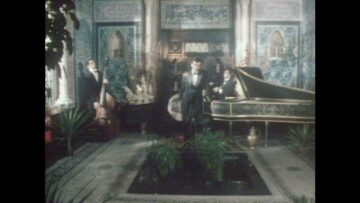


Ottawan – Hands Up (Give Me Your Heart)
Named After A Canadian City They Never Visited While Recording In Paris
Released in March 1981, Ottawan’s “Hands Up (Give Me Your Heart)” became the French disco duo’s second-biggest international hit after their 1979 smash “D.I.S.C.O.”, reaching the top five across Europe and spending eight consecutive weeks at number one in New Zealand. The song peaked at number three in the UK after fifteen weeks on the chart, number two in the Netherlands, number three in Belgium, and number five in Germany. Despite the Canadian-sounding name, the group formed in Paris when French producer Daniel Vangarde discovered Patrick Jean-Baptiste performing with his band Black Underground in a Parisian club. Vangarde and Belgian producer Jean Kluger created Ottawan as a studio project, naming it after a trip to Ottawa, Canada, though the group ironically never visited the city. Jean-Baptiste, born 6 April 1954 in Guadeloupe, and singer Annette Eltice, born 1 November 1958 and also of Caribbean origin, fronted the act while Vangarde and Kluger wrote and produced all material. The song wasn’t released in North America until 1991 as a remix, arriving a decade late to the continent that inspired their name.
The chart performance demonstrated Ottawan’s continued European dominance following “D.I.S.C.O.”‘s massive success in 1980 when it reached number two in the UK and stayed on the charts for eighteen weeks, selling over 612,000 copies in France alone and over ten million worldwide. “Hands Up” nearly matched that achievement, with its New Zealand performance particularly impressive, holding number one for eight consecutive weeks during 1982 and becoming one of the biggest hits in that market for the year. The follow-up single “Help, Get Me Some Help” failed to crack the top forty anywhere, though it appeared in the Ottawan Megamix that circulated on twelve-inch vinyl. In 1987, Club Med commissioned Sway, a one-off Canadian vocal group featuring Vivienne Williams, Sharon Lee Williams, and Colina Phillips with production by reggae musician Carl Harvey, to re-record the song as a commercial jingle for television advertising. That version reached number seven on Canada’s RPM charts in 1988 and earned a Juno Award nomination for Best Single at the Juno Awards of 1989.
Daniel Vangarde’s career trajectory shaped Ottawan’s sound and commercial approach. Born Daniel Bangalter in 1947, he became heavily inspired by the Beatles as a teenager, particularly Paul McCartney. His brother lived in Brighton, England, allowing them to acquire Beatles records before they were widely available in France. Vangarde once wrote a letter suggesting the Beatles let him join but never sent it. He chose the professional surname Vangarde after the Vickers Vanguard aircraft, having originally wanted Morane after the Morane-Saulnier planes but finding it already taken when registering with SACEM. His breakthrough came choreographing a dance for “Casatschok” produced by Jean Kluger for Dimitri Dourakine. In 1971, Vangarde and Kluger created “Yamasuki” under the name the Yamasuki Singers, leading to the album Le Monde Fabuleux Des Yamasuki. The song “Aieaoa” from that album was later recorded as “Aie a Mwana,” first by Black Blood in 1975 and then by Bananarama, becoming the latter group’s first UK hit in 1981.
Recording took place in Paris during 1980 and early 1981 at multi-track studios where Vangarde oversaw creative direction and Kluger handled business management, mixing, and co-writing credits. Engineer Philippe Omnès contributed to early sessions, capturing performances with precision to support Vangarde’s vision. The production blended electronic and live elements, with Vangarde’s arrangements emphasizing catchy hooks and rhythmic drive that defined the Eurodisco sound. Additional collaborators included string arrangers who added orchestral swells, enhancing dramatic builds. The track lasted approximately three minutes thirty seconds for the single version, with extended versions running over six minutes for twelve-inch releases catering to club play. The song featured both English and French versions, with “Haut les mains (donne moi ton cœur)” being a near translation of the English version. The production emphasized danceability above all, keeping tempos consistent at 123 BPM to maintain energy on disco floors.
“Hands Up (Give Me Your Heart)” appeared on Ottawan’s second album released in 1981, following their 1980 debut D.I.S.C.O. which had featured the massive title track alongside “You’re OK” and other dance floor fillers. The group’s output remained prolific during their peak years, with additional singles including “Doudou Rumba,” “Siesta for Two,” and “It’s a Top Secret.” By 1982, the disco wave had receded, and Ottawan’s chart presence diminished though they continued performing and recording through the decade. The group faced complications when multiple lineups emerged claiming to be the original Ottawan, with companies in Eastern Europe and the UK reserving trademarks for the name. Vangarde and Kluger, as founders and rights holders, remained largely uninvolved in these disputes, having already recovered their investment and continuing to receive payments as the true copyright owners.
Vangarde’s most significant cultural contribution came through his son Thomas Bangalter, who formed Daft Punk with Guy-Manuel de Homem-Christo. Vangarde credited himself with aiding the duo in their early musical career, though he retired from music upon hearing their work, telling NME in 2022 that he was doing dance music and when he heard Daft Punk, he said to himself “No, it’s a new generation coming. I cannot compete with this music.” After retirement, Vangarde moved to Caraíva, Bahia, Brazil, where he opened various businesses including a pizzeria, an inn, and a store. The irony of the Eurodisco pioneer’s son revolutionizing electronic music decades later demonstrates how musical innovation passes through generations. Thomas Bangalter grew up hearing his father’s productions, internalizing the emphasis on rhythm and hooks that would later define Daft Punk’s approach even as they pushed into entirely new sonic territory.
The legacy of “Hands Up” extends beyond its chart performance into cultural ubiquity. The song became a staple at European disco nights, wedding receptions, and nostalgia events celebrating early eighties pop. Multiple compilations featured it, particularly greatest hits packages and Eurodisco collections. The Club Med commercial version introduced it to North American audiences who’d never encountered the original, making it simultaneously familiar and unknown in that market. The simple, repetitive hook proved ideal for sing-alongs, with crowds across Europe raising their hands on command for decades after the song’s peak. Modern DJs continue programming it for retro sets, where its unabashed cheerfulness and uncomplicated joy feel refreshingly direct compared to contemporary production complexity. The song has been sampled and referenced in subsequent dance tracks, though specific instances remain difficult to document given the proliferation of bootleg remixes and unofficial releases.
Looking back, “Hands Up (Give Me Your Heart)” represents the final gasp of Eurodisco before the genre’s commercial decline accelerated in 1982 and 1983. The song arrived at disco’s twilight, succeeding through pure exuberance rather than innovation. Vangarde and Kluger understood their audience perfectly, delivering exactly what disco floors demanded: a relentless beat, memorable hook, and lyrics simple enough to scream while dancing. The fact that they named the group after a Canadian city they never visited while recording in Paris encapsulates Eurodisco’s delightful absurdity, where authenticity mattered less than effect and geographic specificity served as exotic window dressing for universal dance floor abandon. Patrick Jean-Baptiste and Annette Eltice became the faces of music they didn’t write, fronting a project masterminded by producers who understood pop construction better than most. That the song still fills dance floors four decades later, that crowds still raise their hands on cue, that the hook remains instantly recognizable proves Vangarde and Kluger’s commercial instincts were sound. Sometimes the simplest formulas endure longest. Sometimes a song about giving your heart while putting your hands up needs nothing more than that to become immortal. And sometimes naming your act after a city you’ll never visit turns out to be the perfect metaphor for disco itself: gloriously fake, wonderfully fun, and impossible to resist when that beat drops.
SONG INFORMATION
Related videos
 Watch LaterAdded
04:42
Watch LaterAdded
04:42  Watch LaterAdded
04:43
Watch LaterAdded
04:43  Watch LaterAdded