








Laid Back – Sunshine Reggae
Two Danes Made Reggae In Copenhagen And Germany Made It Number One
Released in July 1983, Laid Back’s “Sunshine Reggae” transformed two blond-haired Copenhagen studio musicians into unlikely reggae ambassadors. The Danish electronic duo of Tim Stahl and John Guldberg topped the charts in Germany and Austria in September 1983, peaked at number three in Italy, number four in the Netherlands and Flanders Belgium, and number nine in Switzerland. The song’s unexpected success came two years after Bob Marley’s death, during a period when authentic Caribbean reggae dominated the genre. Yet here were two Scandinavians creating what critics called a pop hybrid featuring soft synths, strolling basslines, easy drum machine loops, and vocals floating on a coastal breeze. The B-side “White Horse” became their only US hit, reaching number 26, while “Sunshine Reggae” achieved surprising popularity in South America. The track appeared on their second album Keep Smiling and inspired the 1983 German comedy film Sunshine Reggae in Ibiza, which premiered on 11 November 1983.
The chart dominance in German-speaking territories proved particularly remarkable given the song’s origins. Laid Back had released their self-titled debut album in 1981, spawning the single “Maybe I’m Crazy” which topped the Danish charts but failed internationally. Their next three singles including “Bolivia” barely registered outside Denmark. Then “Sunshine Reggae” exploded across Europe during summer 1983, becoming the international hit that had eluded them. The song spent weeks atop German charts while synth-pop, rock, and post-disco dominated elsewhere. Its success demonstrated European audiences’ appetite for escapist summer music that didn’t demand authenticity, just good vibes. The extended twelve-inch version running six minutes thirty-two seconds became a dance floor staple, featuring additional instrumental breaks and dub-influenced extensions that enhanced its appeal while maintaining the core groove.
Stahl and Guldberg met in the mid-1970s, playing together in a group called Starbox Band. That outfit supported The Kinks during a tour but delivered a performance so poorly received the band split up immediately afterward. Rather than abandoning music, Guldberg set up a Copenhagen studio where he and Stahl continued experimenting with electronic sounds and unconventional arrangements. Their approach blended electronic music experimentation with pop accessibility, creating tracks that stood apart from both mainstream radio fare and underground electronic movements. By 1982, they’d developed the sound that would define “Sunshine Reggae”, recording in Copenhagen during a period when Danish musicians rarely achieved international recognition. The duo became the only Danish act to chart in multiple international territories during the early eighties.
Recording took place at Guldberg’s Copenhagen studio during 1982 and early 1983. The original seven-inch single version ran four minutes eight seconds, serving as the standard radio edit with its laid-back reggae rhythm and minimalistic production. The album version on Keep Smiling extended slightly to four minutes sixteen seconds, incorporating subtle refinements for better integration within the full-length record. Various European labels handled distribution, with Metronome managing the Danish home market and Scandinavia, Polydor covering broader European territories including France and Germany, while Sire Records issued it in the United States. Atlas Records handled Italian distribution, where the single bore notation as theme music for Italian TV program “Uno Estate.” CBS managed Spain and select other areas. Some pressings featured incorrect playing times on the A-side label listing four minutes eight seconds when the extended version actually played. The production emphasized simplicity over complexity, creating what one contemporary reviewer called a musical hammock when the world seemed noisy and fast.
“Sunshine Reggae” appeared on Keep Smiling, the album that established Laid Back’s international profile following their Danish-only success. The record showcased their ability to blend electronic elements with reggae, funk, and pop influences while maintaining accessibility. Other tracks on the album failed to replicate “Sunshine Reggae”‘s commercial breakthrough, though the duo would score another hit later with “Bakerman” in 1989. The album arrived during a transitional period in European pop, when synthesizers were reshaping traditional genres but audiences still craved organic warmth. Laid Back threaded that needle by using electronic production to enhance rather than replace the human elements, particularly in Stahl and Guldberg’s understated vocal delivery. The duo’s laid-back aesthetic became their calling card, distinguishing them from more aggressive synth-pop contemporaries.
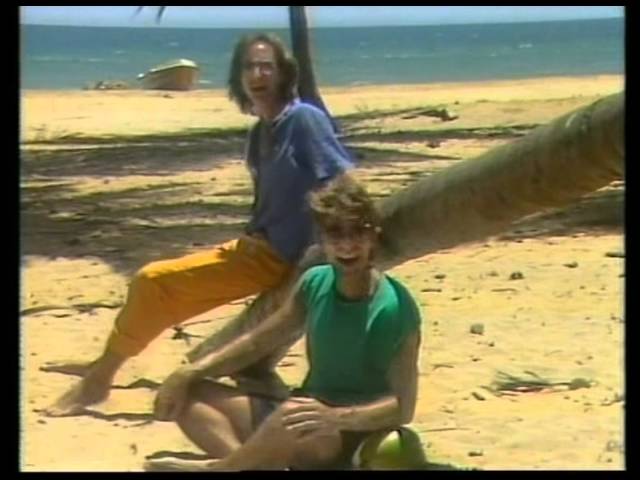
The music video amplified the song’s escapist themes through vivid contrasts. Filmed in Sri Lanka to capture genuine tropical warmth, the approximately four-minute video showed the band as dreary office workers suffering in the heat, since air conditioning remained a science fiction concept in 1983. The video featured two great stereotypes: the beautiful blonde colleague and the older balding colleague attempting humor with jokes and weird ideas, eliciting desperate reactions from the girl. When one of the duo starts composing “Sunshine Reggae”‘s lyrics on a typewriter, the entire office teleports to a Caribbean beach featuring jokes, slightly ridiculous scenes, and postcard smiles. Local Sri Lankan residents join the group, adding joy and lightheartedness. The video emphasized freedom and sunshine through sunset vistas and carefree imagery, aligning perfectly with the song’s optimistic tone. It played with fantasy without requiring plot, simply offering a musical escape from mundane reality.
The German comedy film Sunshine Reggae in Ibiza cemented the song’s cultural resonance beyond music charts. Directed by Franz Marischka and starring Karl Dall, Olivia Pascal, and Chris Roberts, the film premiered on 11 November 1983 in Darmstadt. The plot followed Karl, a simple farmer who takes a plane to Ibiza determined to meet Lina, a pop singer currently touring the island. Karl has fallen in love with his idol through her music and written numerous love letters, though a farmer like Karl seems unlikely to win a pop star’s heart. The film featured the song uncredited on its soundtrack, linking “Sunshine Reggae” to Ibiza’s emerging party culture and portraying holiday revelry that mirrored the song’s easygoing message. The movie included numerous German schlagers including Karl Dall’s “Itzi Bitzi Ibiza.” Shot in Hamburg, Ibiza, and Ostfriesland, the film amplified the track’s status as more than a hit, transforming it into an emblem of European summer escapism.
Critical reception split between praise for its catchy hook and feel-good fusion versus criticism for lacking depth compared to authentic reggae. Contemporary English-language publications offered limited reviews, though European critics embraced its summer vibes. Later retrospectives emphasized the song’s enduring chill-out appeal, positioning it as a staple for lounge music and summer playlists. Commentators observed that while it lacked the lyrical or musical depth of Bob Marley, it succeeded as breezy novelty rather than profound genre contribution. The electronic synth elements drew mixed responses, with some praising accessibility and broader reggae reach to synth-pop audiences, while others criticized dilution of authentic Jamaican roots with commercial derivative sounds. The 2000 remix titled “Laid Back vs. Funkstar’s Pool Party De Luxe Mix” running seven minutes four seconds introduced the song to club audiences decades after its initial release.
The song’s endurance proves remarkable given its seemingly disposable summer hit origins. Decades later it remains a staple of chill-out playlists, retro beach bars, and compilations for when life needs slowing down. Radio spins documented in 2021 showed continuing play in Germany, Chile, Argentina, Turkey, Spain, and Denmark, demonstrating its cross-generational and cross-cultural appeal. The 2008 remaster introduced it to digital streaming platforms where it found new audiences unfamiliar with eighties European pop. Unlike many period pieces locked to their era, “Sunshine Reggae” transcended its moment precisely because it never tried being trendy. Instead, Laid Back created something timeless through simplicity, offering three and a half minutes of uncomplicated joy when complexity dominated.
Looking back, “Sunshine Reggae” represents an unlikely triumph that shouldn’t have worked but did spectacularly. Two Danes making reggae in Copenhagen during 1982 faced steep odds against Caribbean competition and synth-pop dominance. Yet their willingness to embrace electronic production while maintaining reggae’s core relaxation proved inspired. The song conquered German-speaking Europe while Bob Marley’s legend still loomed large, not by competing with authenticity but by offering something different: electronic escapism wearing reggae’s casual clothes. Stahl and Guldberg never achieved sustained international fame, though they continued releasing albums and performing through subsequent decades. But for one glorious summer in 1983, they created the soundtrack for European holidays, Ibiza dreams, and office workers fantasizing about teleporting to Sri Lankan beaches. The song that started as Copenhagen studio experimentation became Germany’s number one, proving that sometimes the most unlikely combinations produce the most enduring results. As those opening synth notes still trigger instant recognition forty years later, “Sunshine Reggae” remains what Laid Back always intended: a musical vacation requiring no passport, just three minutes of letting good vibes get a lot stronger.
SONG INFORMATION
Related videos
 Watch LaterAdded
 Watch LaterAdded
05:26
Watch LaterAdded
05:26  Watch LaterAdded
09:09
Watch LaterAdded
09:09