






![ZZ Top – Sharp Dressed Man (Official Music Video) [HD Remaster]](https://musicvideosclub.com/wp-content/uploads/2025/12/zz-top-sharp-dressed-man-officia-360x203.jpg)




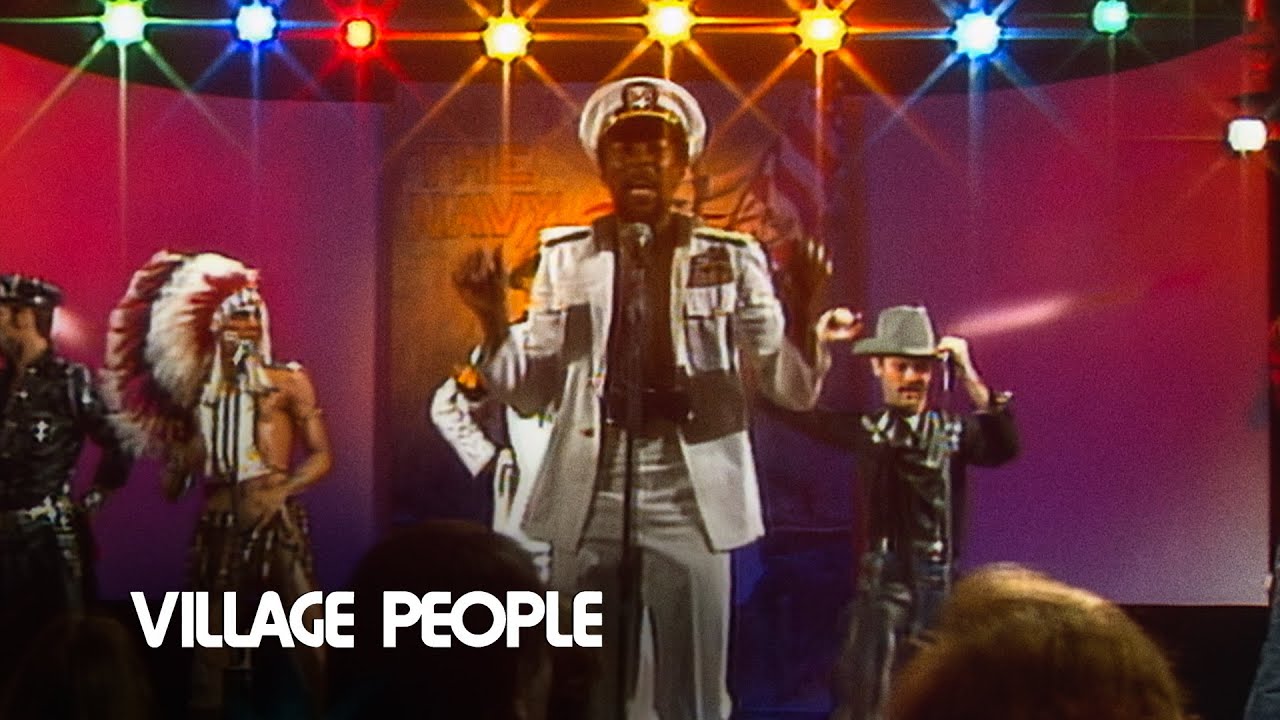
Village People – In The Navy
The Navy Wanted It For Recruitment Then Realized What “Signing Up New Seamen Fast” Meant
Released in March 1979 as the lead single from Go West, Village People’s “In The Navy” became their last top ten hit in the United States, peaking at number three on the Billboard Hot 100 while topping charts in Canada, Japan, the Netherlands, and Belgium’s Flanders region. The United States Navy contacted manager Henri Belolo after the massive success of “Y.M.C.A.”, requesting permission to use the song as their official recruitment tool for television and radio campaigns. Belolo agreed to provide the rights free on one condition: the Navy had to help them film the music video aboard an actual warship. Less than a month later, the group arrived at Naval Base San Diego where they filmed on the deck of the berthed Knox-class frigate USS Reasoner. But upon closer inspection of lyrics like “They’re signing up new seamen fast” and “Don’t you wait to enter,” the Navy began seeing double entendres everywhere and ultimately chose to stick with the traditional “Anchors Aweigh” for recruiting purposes, never using the Village People video despite having facilitated its production.
The chart performance demonstrated the group’s continued commercial power following their breakthrough. The single reached number two in the UK and spent fourteen weeks on the chart, number two in Ireland and Norway, number five in Australia, number seven in Germany, and number eight in Switzerland and Austria. A 1994 remix briefly returned it to the UK charts at number thirty-six. The song became number one hits in territories as diverse as Canada, where it topped the RPM 100 Singles chart, and Japan, where it dominated during spring 1979. In the Netherlands it achieved the group’s second Dutch number one following “Y.M.C.A.” The global success proved ironic given the Navy’s ultimate rejection of what seemed like perfect free advertising. Yet the controversy only amplified the song’s popularity, with audiences either oblivious to or delighted by the perceived subtext that made military brass uncomfortable.
Victor Willis, Henri Belolo, and Jacques Morali wrote the song specifically as a follow-up to “Y.M.C.A.”, which had unexpectedly become both an unofficial for the YMCA organization and a powerful advertising tool despite—or because of—its perceived gay themes. Willis, who performed as both the cop and naval officer in Village People, has consistently maintained there were no intended homosexual references in any of the songs. In multiple interviews, he stated the Navy and general public applied those meanings on their own, noting he isn’t even gay despite fronting a group whose other members were openly so. The lyrics were written as straightforward recruitment advertising encouraging young men to join the Navy for adventure, travel, and camaraderie. Lines like “sail the seven seas,” “put your mind at ease,” “protect the motherland,” and “join your fellow man” read like official Navy copy. The song’s structure even included spoken interjections mimicking recruiting conversations, with responses like “But I’m afraid of water!” and “I get seasick even watching it on TV!” adding humor.
Recording took place during late 1978 and early 1979 with production by Jacques Morali, who’d created the Village People concept as a symbolic group of American masculinity and macho gay-fantasy personas. The studio band Gypsy Lane provided instrumentation under the musical direction of Horace Ott, who’d conducted arrangements since the group’s 1977 debut. The track featured Willis on lead vocals with backing chorus provided by Alex Briley (G.I.), David Hodo (construction worker), Glenn Hughes (leatherman), Randy Jones (cowboy), and Felipe Rose (Native American). The production emphasized disco’s euro-influenced sound with string arrangements, handclaps, and propulsive rhythm section. The song lasted approximately three minutes thirty-five seconds for the single version, with extended disco mixes running over six minutes for twelve-inch releases. The B-side “Manhattan Woman” received a special twelve-inch disco version running six minutes fifty seconds, becoming a club favorite in its own right.
“In The Navy” appeared as the opening track on Go West, the group’s fourth studio album released in March 1979. The album marked the peak of Village People’s commercial success, with the title track “Go West” later becoming a massive hit when covered by Pet Shop Boys in 1993. Other tracks included “I Don’t Want to Be a Hero,” “Citizens of the World,” and “The Women.” The album’s release coincided with disco’s commercial zenith, just months before the July 1979 Disco Demolition Night at Chicago’s Comiskey Park that symbolically marked the genre’s mainstream decline. Village People performed “In The Navy” on television shows worldwide, with their costumes and choreography becoming as recognizable as the music itself. Willis would leave the group in August 1979 during production of the film Can’t Stop the Music, replaced by Ray Simpson, brother of Valerie Simpson of Ashford & Simpson.
The USS Reasoner video shoot became legendary in music video history despite the Navy’s ultimate rejection of the song for recruitment. Director Jacques Scandelari filmed the group performing in their iconic costumes on the frigate’s deck, with actual sailors appearing as extras. The video received heavy rotation in Europe where music videos had found television outlets before MTV’s 1981 American launch. The clip showcased each member’s character: Willis in naval officer whites, Briley in military fatigues, Hodo in construction gear, Hughes in leather, Jones in cowboy attire, and Rose in Native American regalia. The naval setting amplified the song’s camp appeal while providing genuine military backdrop that made the disconnect between intent and interpretation more amusing. When the Navy realized the implications of “signing up new seamen,” they quietly shelved the project, though bootleg copies circulated widely. A second music video was produced in 1996 for the comedy film Down Periscope, featuring the cast and clips shown during end credits.
The 2012 copyright lawsuit became a landmark case for musicians’ rights. Victor Willis filed to reclaim copyrights under the Copyright Act of 1976’s termination provisions, which allow creators to recover rights signed away after thirty-five years. U.S. District Judge Barry Ted Moskowitz ruled Willis could recover his share of copyrights to songs he co-wrote, including “In The Navy,” “Y.M.C.A.,” “Go West,” “Macho Man,” and others. Willis ultimately regained ownership of thirty-three songs, receiving his thirty-three percent share of copyrights effective 1 January 2013. The ruling’s significance extended beyond Village People, establishing precedent for artists like Bob Dylan and Tom Petty who’d filed similar claims. Willis told the New York Times he’d learned over years that awesome powers associate with copyright ownership, noting he could now stop performances of his music if desired and might object to certain usages including current Village People tribute acts touring under the name.
Looking back, “In The Navy” represents disco’s capacity for simultaneous sincerity and camp, straightforward messaging and layered subtext, commercial calculation and cultural commentary. The Navy approached Village People wanting the same recruitment boost “Y.M.C.A.” had provided the YMCA, apparently missing that song’s own contested interpretations. When they actually examined “In The Navy”‘s lyrics, the unintended implications became too obvious to ignore. Willis maintains the song was written innocently, the Navy and public projecting meanings he never intended. Yet the genius of Village People’s output was precisely that deniability, the ability to function simultaneously as straightforward pop and knowing commentary depending on the listener’s awareness. The group that began targeting disco’s gay audience quickly moved mainstream, their characters becoming beloved American archetypes divorced from their original context. The song that almost became official Navy recruitment material instead became a disco classic precisely because it could never escape the question of whether it was selling Navy life or cruising for sailors. As the Navy discovered too late, some invitations arrive first class whether you requested them or not, and sometimes signing up new seamen fast means something entirely different than intended.
SONG INFORMATION
Related videos
 Watch LaterAdded
03:54
Watch LaterAdded
03:54  Watch LaterAdded
05:08
Watch LaterAdded
05:08 ![The Rolling Stones – Brown Sugar [Live] HD Marquee Club 1971 NEW](https://musicvideosclub.com/wp-content/uploads/2025/12/the-rolling-stones-brown-sugar-l-360x203.jpg) Watch LaterAdded
Watch LaterAdded